


money counting machine
Money Counter for Fruit & Vegetable Markets: The Right Device for the Yard, the Office and the Shop
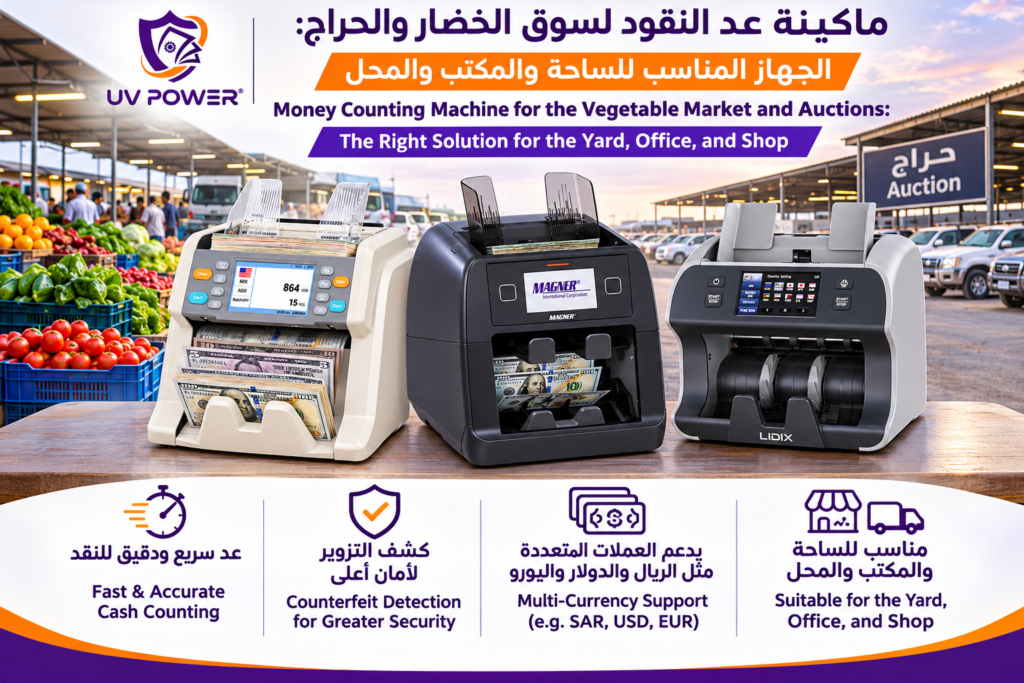
Nov
The vegetable market auction starts before dawn. Lorries unload, the auctioneer raises the price per pallet, and a trader buys a whole load and pays in cash from a bundle in his pocket. Hours later, the same cash moves to retail shops, then comes back to the market the next day. In this cycle, notes pass through many hands, get dirty and creased, and are counted in a hurry every time.
This article is for wholesale traders in fruit and vegetable markets, retail shop owners, and the accountant of a company selling at the auction. We will pinpoint where cash goes missing in this trade, why manual counting is not enough here, and which device suits each location: the stall, the shop and the trader's office.
The short answer: a money counter for a vegetable market must suit the place where it is used, above all. In the yard without a steady power supply, a battery-powered counter. In the office, where large bundles of worn notes are counted, a heavy-duty counter. In the retail shop, a simple counter that shortens closing.
What makes cash in a vegetable market different?
Speed above everything
Produce spoils and buyers do not wait. At the auction a deal is closed in minutes and paid on the spot. There is no time to count a bundle note by note, or to hold every note up to the light.
Heavily used notes
Cash in the vegetable market circulates daily between traders, workers and drivers. Many notes arrive dirty, creased or taped. These notes wear out manual counting, and also simple counters that may reject them or stop at them.
Wholesale and retail in one day
A wholesaler receives large sums of mixed denominations in the morning, then may sell retail at midday with small invoices. A small shop buys at the auction in cash and sells to consumers for cash.
Several workers and repeated handovers
The worker takes cash from the buyer and hands it to the supervisor, who hands it to the owner or accountant. Every handover without a documented figure is a potential dispute.
| Location | Nature of cash | Main problem |
|---|---|---|
| Auction yard and stalls | Mixed bundles received quickly, no steady power | Accurate counting on site is not possible |
| Wholesaler's office | Large sums from several workers and customers, worn notes | Counting takes time and the counter keeps stopping |
| The retail shop | Many small invoices | Closing the drawer at the end of the day |
Where does money leak in a vegetable market?
Errors in counting bundles. When a large bundle is counted quickly in the yard, two notes stuck together or a short bundle are only discovered at closing, when it is hard to know which deal caused it.
Counterfeit notes in the rush. There are no published figures we can rely on for counterfeit rates in vegetable markets, and we will not invent one. But auction conditions make checking hard: dawn lighting, speed, and bundles passing from hand to hand. And a counterfeit note here is paid against produce that has gone and will not come back.
Handover between worker and accountant. If a worker hands over an amount he says is a certain figure, and the accountant counts it later and finds less, the dispute cannot be settled because nobody counted in front of the other.
Why is manual counting not enough?
Manual counting works well when cash is limited and time is available. In the vegetable market, neither is the case. Dirty and creased notes make manual counting slower and more error-prone: two notes stuck together are counted as one, and a folded note gets lost in the bundle.
More importantly, manual counting does not check the note. Experience catches an obvious fake, but with a bundle of a hundred dirty notes at four in the morning, experience alone is not enough.
Which device suits each location?
In the yard and at stalls: battery-powered counting
If collection happens in the yard away from a power socket, the U-P200 Battery runs on a rechargeable battery, counts notes and checks with UV, magnetic and IR sensors, with a two-year warranty direct from UV Power. But note: it counts the number of notes only and does not calculate value, so work out the amount after sorting denominations, or use it to confirm the number of notes in a single-denomination bundle. Details in Battery-powered money counter.
In the wholesaler's office: mixed counting that keeps going
When cash from workers and customers comes together in the office in mixed denominations, sorting by hand takes longer than the count itself. U-P2000 counts mixed denominations and gives the count of each denomination and the total, sends rejected notes to a second pocket and keeps counting, with dual CIS, IR, MG, MT and UV sensors and a 3-year warranty direct from UV Power. The second pocket really shows its value with worn notes: the counter does not stop at every note it rejects.
And if the trader counts large volumes of worn notes every day, the product page for the Lidix CL-2 states that it suits worn banknotes and heavy-duty use, with mixed counting and dual CIS, IR, IRT, MG and UV sensors. It is made in Korea, with a two-year warranty direct from UV Power. The choice between it and the U-P2000 depends on your daily counting volume and the condition of the notes you receive.
For the record: who handed over how much?
To end disputes between worker and accountant, the figure must be in writing. That is where the report printer comes in: compatible with the U-P2000, it prints the note count, denominations and total value, so the worker and the receiver sign the same slip. And if the accountant wants a digital record for each day, the Counting Management Software saves count results and exports reports in PDF and Excel.
In the retail shop: closing without sorting
A fruit and vegetable shop selling to consumers fills its drawer with small denominations. U-P300 is enough if you sort notes by denomination before counting, as it calculates the value of a single-denomination batch and checks with UV, magnetic and IR sensors. And if the drawer is mixed and closing is late, the U-P500 counts mixed denominations and gives the total directly.
Checking before accepting
In the shop, where there is a counter and power, the U-P10 counterfeit detector checks large notes with UV light and a magnetic sensor before change is given. In the yard, the practical solution is to train workers on the basic security features of SAR 100 and SAR 500 notes; the guide is in security features of the Saudi riyal.
A suggested end-of-auction procedure
- Each worker hands in his cash with a list of the deals he collected.
- The cash is counted in the office in front of him, with the figure shown on the display.
- Rejected notes are checked by hand and recorded separately.
- The count slip is printed and signed by the worker and the receiver.
- The total is matched against the list of deals before the worker leaves.
Objections from vegetable market traders
“A counter won't cope with market notes”
Counters differ here. A single-pocket counter stops at every note it rejects, which is tiring with worn notes. That is why we recommend a two-pocket counter such as the U-P2000 for the office, or a counter whose page states it suits worn notes, such as the Lidix CL-2. Regular care keeps the counter performing well, as explained in money counting machine maintenance.
“We have counted by hand for years without a problem”
Perhaps there has been no big problem, but do you know exactly how much time daily counting takes? And how many small differences went unexplained? A counter does not fix one big problem; it prevents dozens of small discrepancies that nobody notices.
“The market is an open space and the device will get damaged”
Keep the mains-powered counter in the office, not in the yard. In the yard, use the battery-powered counter to confirm note counts only, then complete the exact count in the office.
Frequently asked questions
Is there a money counter that works without mains power for a vegetable market?
Yes. The U-P200 Battery runs on a rechargeable battery and counts the number of notes while checking with UV, magnetic and IR sensors, but it does not calculate value.
Which counter suits dirty and worn notes?
A two-pocket counter such as the U-P2000 keeps counting and sets rejects aside. And the Lidix CL-2 product page explicitly states that it suits worn notes and heavy-duty use.
Does a small vegetable shop need a money counter?
If daily cash is small, a detector at the cashier with manual counting may be enough. If closing takes time, the U-P300 is an economical choice with a two-year warranty.
How do I document what each worker hands over at the auction?
Count each worker's cash separately in front of him, print the result on the report printer or save it in the counting management software, and have both sides sign.
Bottom line: the right device in the right place
A vegetable market does not need one counter for every location, but a setup that suits each one:
- Yard and stalls: U-P200 Battery.
- Wholesaler's office: U-P2000 or Lidix CL-2 for worn notes, with the report printer.
- Retail shop: U-P300 or U-P500.
- Checking before accepting in the shop: U-P10 counterfeit detector.
Message us on WhatsApp stating whether you are a wholesaler or a retail shop and how many workers hand you cash each day, and we will recommend the right setup.
