


money counting machine
Saudi Riyal Security Features: How to Check Each Denomination by Hand and with a Money Counter
Nov
The Saudi riyal security features in the sixth issue include two main ones on every paper denomination: the watermark and the metallic strip. The 5-riyal polymer note adds two transparent security windows. This is what is stated by the Saudi Central Bank on its sixth issue page.
This guide covers what to check in each denomination, what a money counter does in the same check, and when a manual check is enough.
What are the Saudi riyal security features for each denomination?
| Class | Security features | Color and size |
|---|---|---|
| SAR 500 | Watermark, and a metallic strip on the left side carrying the Kingdom's emblem and the value | Blue, 166 × 74 mm |
| SAR 200 | Watermark, and a metallic strip on the left carrying the emblem and the value | Grey, 163 × 73 mm |
| SAR 100 | Watermark, and a metallic strip on the left carrying the emblem and the value | Red, 160 × 72 mm |
| SAR 50 | Watermark, and a metallic strip on the left carrying the emblem and the value | Green, 155 × 70 mm |
| SAR 10 | Watermark, and a metallic strip on the left carrying the emblem and the value | Brown, 150 × 68 mm |
| SAR 5 (cotton) | Watermark and metallic strip | Purple, 145 × 66 mm |
| 5 riyals (polymer) | A security window on the left of the front and another on the right of the back, plus a metallic strip | Purple, 145 × 66 mm |
Source: Sixth issue page, Saudi Central Bank.
How do you check the Saudi riyal security features by hand?
- Watermark: Hold the note up to the light and look for the watermark in its place.
- Metallic strip: Make sure it is on the left side and carries the Kingdom's emblem and the value on the SAR 10 to SAR 500 notes.
- Security window: On the 5-riyal polymer note, check the two transparent windows on the front and back.
- Size and color: Compare the suspicious note with a genuine note of the same denomination. Any clear difference in size or color is a reason for a closer check.
What does a money counter check beyond the Saudi riyal security features?
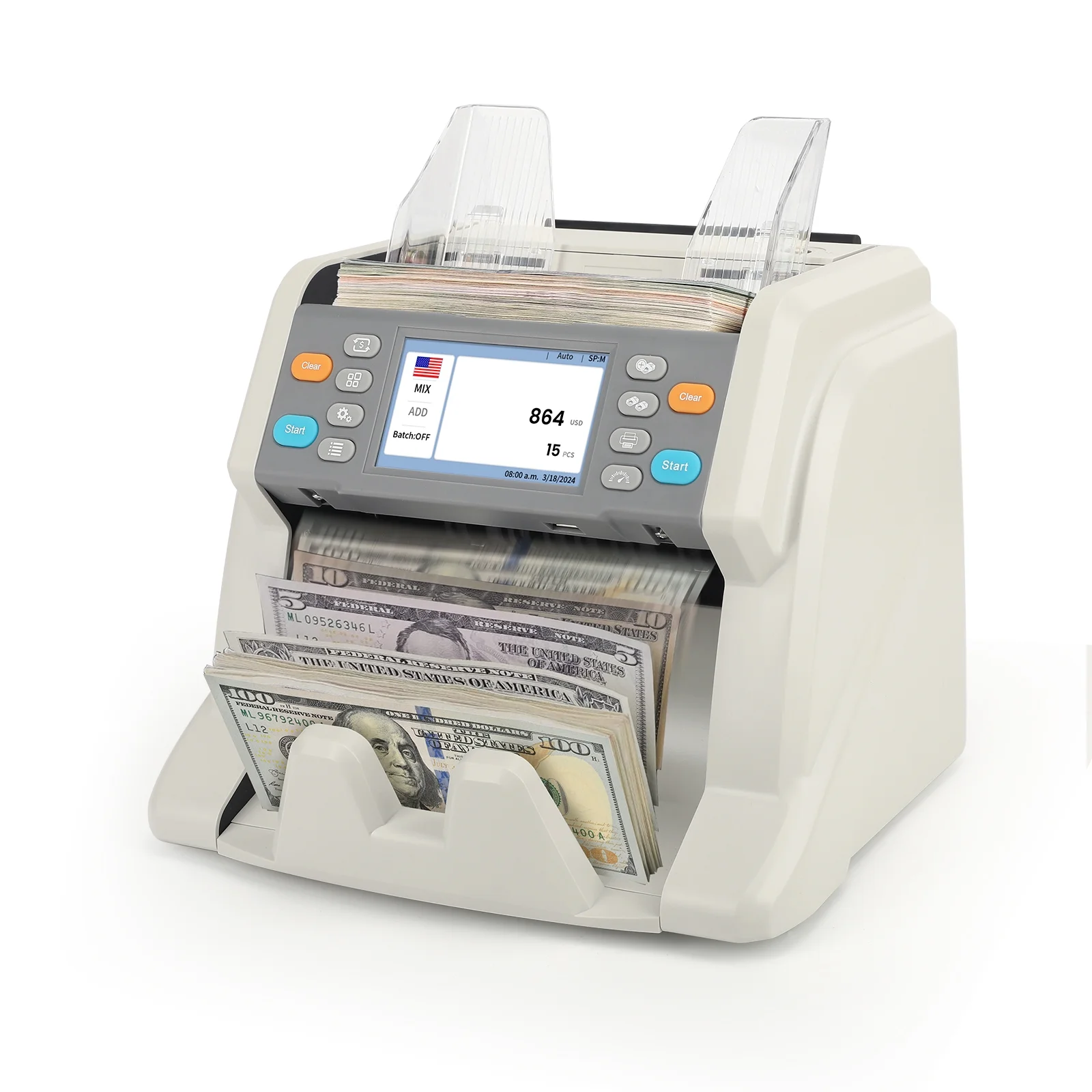
A money counter does not see the watermark the way your eye does. Instead, it checks properties you cannot see, each with a different sensor:
| Sensor | What it checks |
|---|---|
| UV | How the banknote paper behaves under ultraviolet light |
| MG | Magnetic ink |
| IR | Marks that appear under infrared light |
| MT | The metal security thread inside the note |
| CIS | The note's image and denomination |
That is why the two checks complement each other: the machine checks every note quickly, and your eye checks the notes the machine rejected. Sensors are explained in counterfeit detection technologies.
When is a manual check enough, and when do you need a machine?
| Situation | Best fit |
|---|---|
| Few notes a day, and you can check every large note | A manual check, or the U-P10 detector |
| A daily drawer with mixed denominations | A money counter with counterfeit detection, such as L1 or U-P500 |
| Large daily amounts from many sources | A machine with a reject pocket, such as U-P2000 |
Frequently asked questions
Where is the metallic strip on the Saudi riyal? On the left side of the note in the sixth issue; it carries the Kingdom's emblem and the value on the SAR 10 to SAR 500 notes.
What is the difference between the cotton and polymer 5-riyal notes? The polymer note has two transparent security windows, on the left of the front and the right of the back. It was issued on 28 September 2020.
When was the SAR 200 note issued? On 4 January 2021, according to the Saudi Central Bank.
Is a note rejected by the machine necessarily counterfeit? No. It may be folded, dirty or stuck to another note. Check it by hand using the features above.
Want a machine that checks every note before you accept it? Message us on WhatsApp with your daily cash volume, and we will recommend the right machine.
Read also:
- Do money counting machines really detect counterfeit money?
- Updating your money counter for riyal denominations
- The difference between a money counter and a counterfeit detector
