


Professional money counting machines
Money Counting Machines for Banks and Cash-in-Transit Companies: Key Specifications
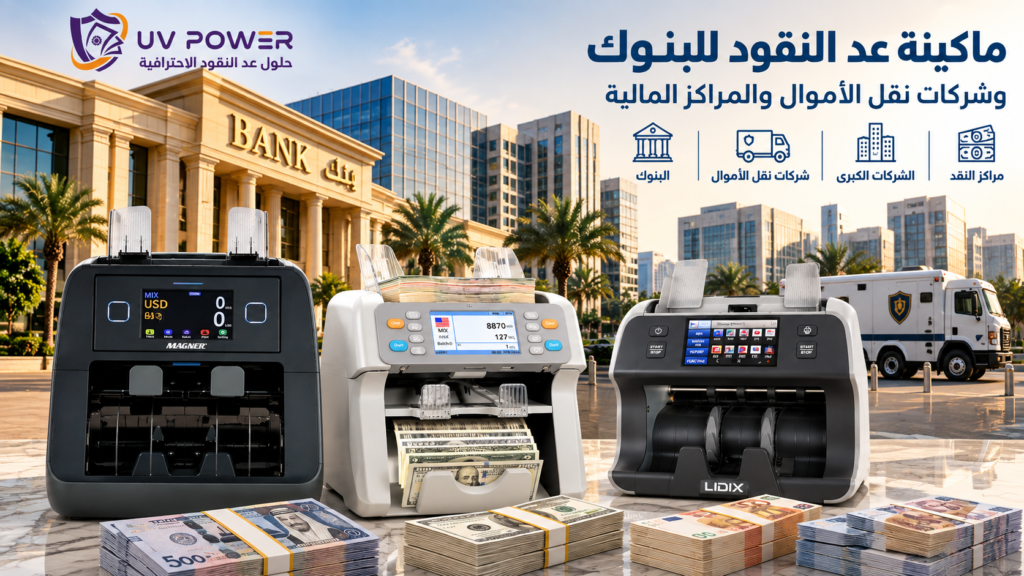
Sep
In short: A bank branch or exchange office needs a machine that combines five functions: mixed denomination counting, multi-technology note checking, a separate reject pocket so counting does not stop, serial number recognition, and reports that can be saved. In the UV Power store, the U-P2000 covers these functions for medium volumes, while high-volume cash processing centers are better served by the Lidix CL-2 or Magner 2000F.
A branch counting customer deposits has different needs from a center that processes cash all day, so define your workload and currencies before comparing.
If you're just starting to compare, you can also see the Money Counting Machine Buying Guide for Saudi Arabia to learn the key factors to review before buying.
Why do banks and cash-in-transit companies need a professional money counting machine?
Cash counting and review are repeated constantly in banks, exchange companies, and cash processing centers. As volumes grow, counting speed, operational stability, and easy review of results become key factors in choosing a machine.
An organization may need functions such as:
- Counting large volumes of banknotes.
- Recognizing different denominations and calculating value when mixed counting is supported.
- Inspecting banknotes using the machine's detection technologies.
- Separating notes that need review from accepted notes during counting.
- Reading serial numbers for the currencies the machine supports.
- Saving counting results and preparing, printing, or exporting reports.
Key specifications of a money counting machine for banks
1. Counting speed and continuous operation
The right counting speed helps process cash in less time, especially as the daily volume of notes passing through the machine grows. However, don't rely on speed alone; also review hopper and stacker capacity, operating modes, and the functions your work environment requires.
2. Mixed counting and value calculation
On machines that support it, mixed counting handles notes of different denominations in one run, recognizing the supported denominations and calculating their value according to the machine's capabilities.
This function is useful when an organization needs to reduce manual sorting and review the total value of notes. Before choosing a machine, check which currencies and denominations it supports in mixed counting mode.
3. Note inspection while counting
Inspection technologies vary from one machine to another and may include UV, IR, MG, CIS, and other technologies in advanced classes. These functions help inspect note features according to the machine's capabilities and supported currencies.
4. Separate reject pocket
A separate pocket for rejected notes is an important feature in some high-volume environments. Instead of stopping to remove a note that needs review, machines with this function can separate it from the accepted notes during counting.
If your organization processes large volumes of cash, it's worth checking how the reject pocket works and how notes flagged for review are handled.
5. Reports and saving counting results
In an institutional environment, an organization may need to keep transaction results and review them later. Some machines offer options to save, print, or export data to a computer, depending on the model.
Before buying, check the available report formats, computer connection methods, data storage capacity, and whether these functions meet your organization's review and cash count procedures.
6. Serial number reading
Some machines can read banknote serial numbers, but the currencies they can read vary from model to model.
If this function matters for your work, check the supported currencies, whether serial numbers can be saved or exported, and whether the machine offers additional functions for comparing or rejecting specific numbers.
U-P500: an option for financial offices and businesses
The U-P500 money counting machine offers a set of functions including mixed counting, a color touchscreen, note inspection technologies, display of results and total value, and report generation.
According to its listed specifications, the U-P500 supports up to 20 currencies, three counting speeds of up to 1,200 notes per minute depending on the setting, a hopper capacity of up to 600 notes, and a stacker capacity of up to 200 notes.
The specifications also include computer connectivity, report export in Excel and PDF formats, and serial number reading for the Saudi riyal, US dollar, and euro.
The U-P500 can be considered for financial offices and businesses that need advanced counting and inspection functions, after confirming the required currencies and features are available on the version offered.
U-P2000: counting pocket and reject pocket
The U-P2000 money counting machine offers multiple cash handling functions, including mixed counting, denomination sorting and batching, plus a counting pocket and a reject pocket.
According to its listed specifications, the U-P2000 supports up to 20 currencies and offers a color touchscreen, the ability to save, print, and export reports, and software updates via USB.
Its listed functions also include serial number reading for the Saudi riyal, US dollar, and euro, and the ability to program the machine to stop at a set count or amount. Hopper capacity is up to 600 notes and stacker capacity up to 200 notes.
This model can be considered by organizations that need broader counting and cash management functions. The final choice still depends on transaction volume, currencies, and required features.
Lidix CL-2: for banking use and high-volume operation
The Lidix CL-2 is offered for intensive professional use; its listed applications include banks, cash-in-transit companies, large businesses, and financial institutions that handle large volumes of cash.
According to its listed specifications, the Lidix CL-2 supports mixed counting, denomination and mixed-currency batching, and offers three counting speeds: 800, 1,000, and 1,200 notes per minute.
The specifications also include a 4.3-inch color LCD touchscreen, a hopper capacity of up to 500 notes, and a stacker capacity of up to 250 notes.
Inspection technologies in the Lidix CL-2
The inspection technologies listed for this model include UV, UVT, MG, IR, and IRT, plus dual CIS sensors. The specifications also include printing reports of counting results and totals, and software update options via SD card, WLAN, and USB.
Magner 2000F: for high-volume cash operations
The Magner 2000F is one of the professional classes worth considering in environments that handle large amounts of cash, such as banks, exchange companies, and cash-in-transit companies.
According to its listed specifications, it has a counting pocket and a reject pocket, with support for mixed counting, single-denomination counting, face and orientation detection, and separation of old and new issues, plus a Fitness function for checking note condition.
Its listed counting speed reaches 1,200 notes per minute, with a color LCD touchscreen, a hopper capacity of up to 500 notes, and a stacker capacity of up to 250 notes. The specifications also indicate support for 30 world currencies.
Inspection technologies and serial number reading in the Magner 2000F
The listed inspection technologies include UV, UVT, MG, IR, and IRR, plus dual CIS sensors and a TDS system for detecting certain defects and irregularities in notes.
The specifications also include an OCR function for reading serial numbers, serial number reading for five currencies, rejection of specific serial numbers, storage of counting records for up to six months, and computer connectivity with report export.
Glory GFS-220F
The Glory GFS-220F can also be considered among advanced options, but define the functions you need and review the model's technical specifications before comparing it with other machines.
To see the available options, you can visit the UV Power store and compare machines according to your organization's needs.
Comparison of professional money counting machines
| Model | Key listed functions | What to check |
|---|---|---|
| U-P500 | Mixed counting, inspection, reports, and serial number reading for three currencies | Supported currencies and the functions your organization needs |
| U-P2000 | Counting pocket and reject pocket, mixed counting, reports, and serial number reading for three currencies | Transaction volume, data storage methods, and updates |
| Lidix CL-2 | Mixed counting, multiple inspection technologies, and report printing | Required speed, currencies, and available connectivity |
| Magner 2000F | Counting pocket and reject pocket, multiple inspection technologies, OCR, and reports | Serial number reading functions and compatibility with the required currencies |
| Glory GFS-220F | To be reviewed per the model's specifications | Required technical features before comparing |
How do you choose the right money counting machine for banks and cash-in-transit companies?
To make the right choice, start by defining your actual operating requirements, then compare machines on the following points:
- Daily cash volume: Determine how many notes you need to count each day.
- Required currencies: List the currencies your organization uses and check that they're supported.
- Counting type: Decide whether you need mixed counting, single-denomination counting, or value calculation.
- Inspection and rejection: Review the detection technologies and whether a separate reject pocket is available if needed.
- Reports: Make sure results can be saved, printed, or exported.
- Serial numbers: Check the supported currencies if this function is necessary.
- After-sales service: Review warranty, maintenance, spare parts, and updates.
- Cost: Compare the price with the functions you'll actually use.
If mixed counting and reports are the priority in a mid-sized operation, you can start by comparing the U-P500 and U-P2000. If your organization needs advanced inspection and sorting functions for intensive use, you can consider the Lidix CL-2 and Magner 2000F based on your operating requirements.
Is counting speed the most important factor?
Speed matters, but it's not the only criterion. An organization may need a machine with a separate reject pocket, detailed reports, serial number reading, or support for specific currencies.
Why reports matter in an institutional environment
Reports help document counting results and review them when needed. They matter even more when transactions are repeated throughout the day or staff need to refer back to previous results.
Maintenance and technical support for money counting machines
Choosing a machine isn't just about technical specifications and price. Availability of maintenance, spare parts, updates, and technical support can affect business continuity, especially when an organization relies on the machine for daily operations.
Before buying, ask about warranty terms, maintenance, and available after-sales services. You can review the UV Power's warranty and maintenance page for published information.
Guide to buying a money counting machine
If you're still comparing different classes, see the Money Counting Machine Buying Guide for Saudi Arabia to learn the key factors that help you choose the right machine.
You can also see the Professional money counting machines to learn about options for companies and businesses that need advanced functions.
To ask which machine best suits your cash operations, Contact UV Power on WhatsApp.
Frequently asked questions about money counting machines for banks
What are the key specifications of a money counting machine for banks?
Key specifications include counting speed, mixed counting, note inspection technologies, hopper and stacker capacity, a reject pocket, reports, and support for the required currencies.
When do I need a two-pocket machine?
A machine with a counting pocket and a reject pocket is useful when you need to separate notes the machine rejects or flags for review from accepted notes during counting.
Is every professional machine suitable for cash-in-transit companies?
No. Machines differ in their functions, capacities, inspection technologies, and results management. So compare the model's specifications with your daily cash volume and operating requirements.
Is the U-P2000 suitable for large businesses?
The U-P2000 can be considered for businesses that need mixed counting, a reject pocket, reports, and additional cash handling functions, after confirming its specifications match the organization's needs.
What is the difference between the U-P500 and U-P2000?
Both count mixed denominations and read serial numbers. The practical difference is that the U-P2000 has two pockets, one for counted notes and one for rejects, so counting continues when a suspicious note appears, while the U-P500 stops so you can remove the note by hand.
Is serial number reading available for all currencies?
Not necessarily. Which currencies' serial numbers can be read depends on the model and its functions, so check the list of supported currencies before buying.
Is maintenance important when buying a professional machine?
Yes. Maintenance, spare parts, technical support, and updates are important for keeping operations running, especially where the machine is used frequently.
Looking for a money counting machine for banks or cash-in-transit companies? Contact UV Power to compare options based on your cash volume, currencies, and the functions you need.
