


money counting machine
Money Counter for Car Washes: Match Cash to Washed Cars on Every Shift
Nov
After the first rain of the season, car washes fill up with queues they have not seen in months. Cars covered in mud and road dust, customers wanting a quick exterior wash, others asking for an interior clean and polish. Workers move between cars, the cashier at the gate takes payment and gives change, and sometimes a worker takes money straight from the customer. At the end of the day comes the question that worries every car wash owner: does the amount in the drawer actually match the number of cars washed?
A car wash owner may think his main problem is the number of cars and the speed of service. But as staff grow and shifts multiply, a less visible problem appears: matching cash to services performed, handing over cash between shifts, and checking notes before accepting them. This article is for car wash owners, operations managers and accountants. It explains how to organise these points, which devices help, and what devices cannot do.
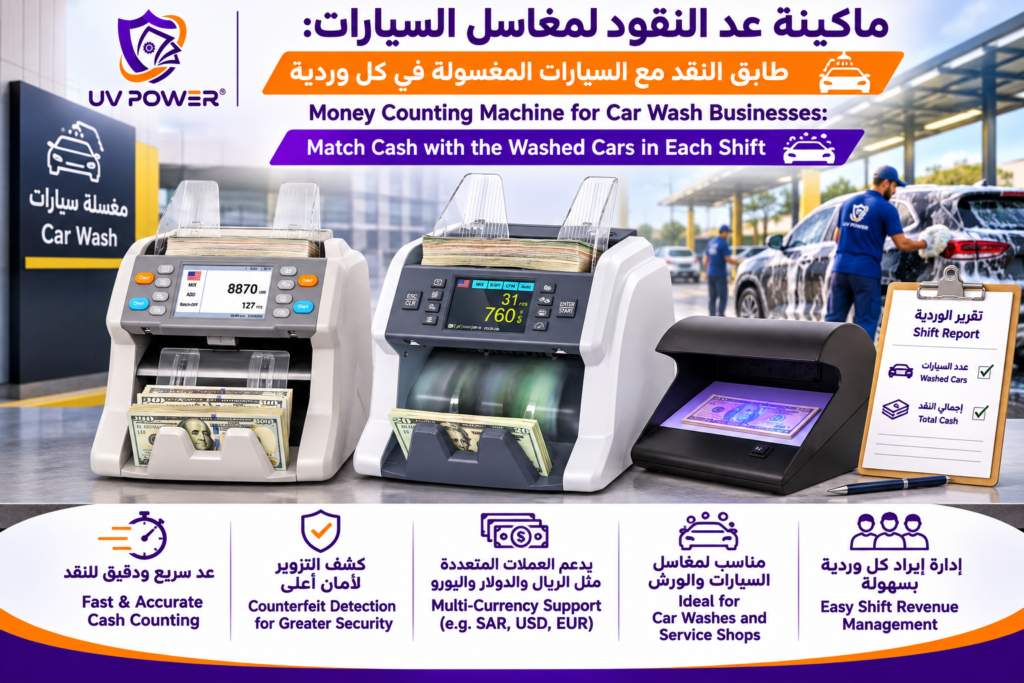
The short answer: a car wash needs a money counter at the closing point to count and document each shift's cash accurately, and a detector at the collection point for large notes. More important than either device: a procedure that links cash to the number of services performed.
Why is cash at a car wash different?
Services at different prices
Exterior wash, interior, full valet, polishing and monthly packages. Each service has its own price, and sometimes a service is added during the job. That makes working out “what should be in the drawer” harder than in a shop selling products at fixed prices.
The weather changes everything
Demand at car washes rises during and after the rainy season and after dust storms, but this varies between cities and locations. We do not have documented figures for the size of the increase and will not assume them. What matters is that a car wash can go from a quiet day to a packed one suddenly, and cash procedures must cope with that.
Many workers and several collection points
At a large car wash, the cashier may take payment at the gate, the polishing worker may take payment for an extra the customer asked for, and the supervisor may take payment for a package. The more hands involved, the harder the reconciliation.
Long shifts
Car washes that open long hours split the work into two or more shifts, and every handover between shifts needs a clear figure.
Where do discrepancies appear?
| Source of difference | How it happens | What helps |
|---|---|---|
| Service performed but not recorded | An extra agreed verbally during the wash | Record every service before starting |
| Wrong change | Crowding at the gate | Count the drawer accurately at every handover |
| Handover without counting | The shift ends and the worker is in a hurry | Count on a machine in front of both sides and sign |
| Counterfeit note | Quick acceptance during the rush | Check large notes before giving change |
Note that no device solves the first row. A money counter counts the cash that is there accurately, but it does not know how many cars were washed. So the solution starts with the procedure, and then the device makes the cash part accurate and documented.
Money counter and detector: two different jobs
This point is worth clarifying because the two are often confused:
- Money Counting Machines belongs at the closing point or the accountant's office. It counts the shift's cash quickly and gives the total, and if it has detection sensors it checks notes during counting and rejects those that do not match.
- A counterfeit detector belongs at the collection point. It checks the note before change is given and before the car leaves.
A money counter with detection sensors catches a suspect note at counting time, after the customer has left. A detector at the gate checks it before that. The full explanation is in The difference between a money counter and a counterfeit detector.
A suggested procedure for the car wash
Before the devices, set these rules:
- Every service is recorded before starting in the POS system or a simple log, including extras.
- A single collection point as far as possible; a worker who takes a payment hands it there immediately.
- Check large notes at the collection point before giving change.
- Count the cash at the end of every shift in front of the outgoing and incoming staff, and match it against the number of services recorded.
- Both sides sign the figure and any difference.
The full cash handover procedure, with a ready-made form, is in cash handover between shifts.
Which devices suit a car wash?
At the collection point
U-P10 counterfeit detector checks the note with a 16W UV lamp and a magnetic sensor, with a magnifier for fine security features and a two-year warranty direct from UV Power. It needs a table and power, so place it at the gate or reception, not in the washing area.
To count the cash: a small car wash with one shift
If the car wash is small and cash is limited, the U-P300 counts notes and calculates the value of a single-denomination batch, checks with UV, magnetic and IR sensors, has a 600-note hopper and a two-year warranty. Notes need to be sorted by denomination before counting.
A car wash with two or more shifts
When handovers repeat and drawers arrive with mixed denominations, mixed counting is what shortens handover time. If the car wash only takes Saudi riyals, the Lite counts L1 counts mixed denominations and gives the total, with CIS, IR, MG, MT and UV sensors, a colour touchscreen, a 300-note hopper and a two-year warranty. If you want more capacity or support for other currencies, the U-P500 has a 600-note hopper and a 3-year warranty.
A chain of car washes or branches
An owner with several branches needs a figure for each branch and each shift, and a record to refer back to:
- the report printer is compatible with U-P300, U-P500 and L1 and prints the note count, denominations and total value at every handover, so both sides sign the same slip.
- Counting Management Software compatible with U-P500 and U-P2000 saves the results of every count and exports reports in PDF and Excel, which helps an accountant reviewing several branches.
What the counter does not do
Expectations should be clear:
- The counter does not know how many cars were washed. Reconciliation needs a service record.
- The counter does not stop a worker from taking money without recording it. The procedure does.
- A counter with detection sensors checks notes according to its sensors, and no device guarantees detecting every type of counterfeit.
What the counter does: it makes counting cash fast, accurate and documented, so any difference comes from services or procedure, not from a counting error. That alone narrows down where to look for the problem considerably.
Objections from car wash owners
“The workers know their job and I don't want to embarrass them”
A clear procedure protects the honest worker first. When the cash is counted in front of him and he signs the figure, there is no room left for suspicion.
“Most customers pay by card”
If cash really is limited, start with a U-P10 at the gate and organised manual counting. If cash floats on busy days are large, add a simple money counter.
“The busy season is only a few days”
It is true that peaks depend on the weather, but the counter is used at every handover all year round. And the busy days are exactly when most mistakes happen.
Frequently asked questions
What is the best money counter for car washes?
For a small car wash, the U-P300; for a car wash with several shifts and mixed denominations, the Lite counts L1 if it only deals in riyals, or the U-P500 for more capacity.
How do I match cash with the number of cars washed?
Record every service before starting, then count the shift's cash on the counter and compare the total with the sum of recorded services. The counter ensures an accurate count; the record tells you what should be there.
Do I need a counterfeit detector if I have a counter with sensors?
Usually yes, because the counter checks at counting time after the customer has left, while the detector at the gate checks before change is given.
Is one counter enough for several branches?
Each branch needs a way to count its cash at handover. Each branch can have a simple counter, with a central record in the counting management software for the accountant.
What warranty do the devices have?
The U-P10, U-P300 and Lite counts L1 carry a two-year warranty, and the U-P500 a 3-year warranty, direct from UV Power according to the product pages.
Bottom line: make discrepancies show up in the right place
A car wash does not need a machine that solves everything, but a procedure linking cash to services, and devices that make the cash part accurate:
- At the gate: U-P10 counterfeit detector.
- Small car wash: U-P300.
- Several shifts, riyals only: Lite counts L1.
- More capacity or other currencies: U-P500.
- Branch records: the report printer or Counting Management Software.
Message us on WhatsApp with the number of shifts and collection points at your car wash, and we will recommend the right setup.
