


money counting machine
What Is the Difference Between a Money Counting Machine and a Counterfeit Detector?
October
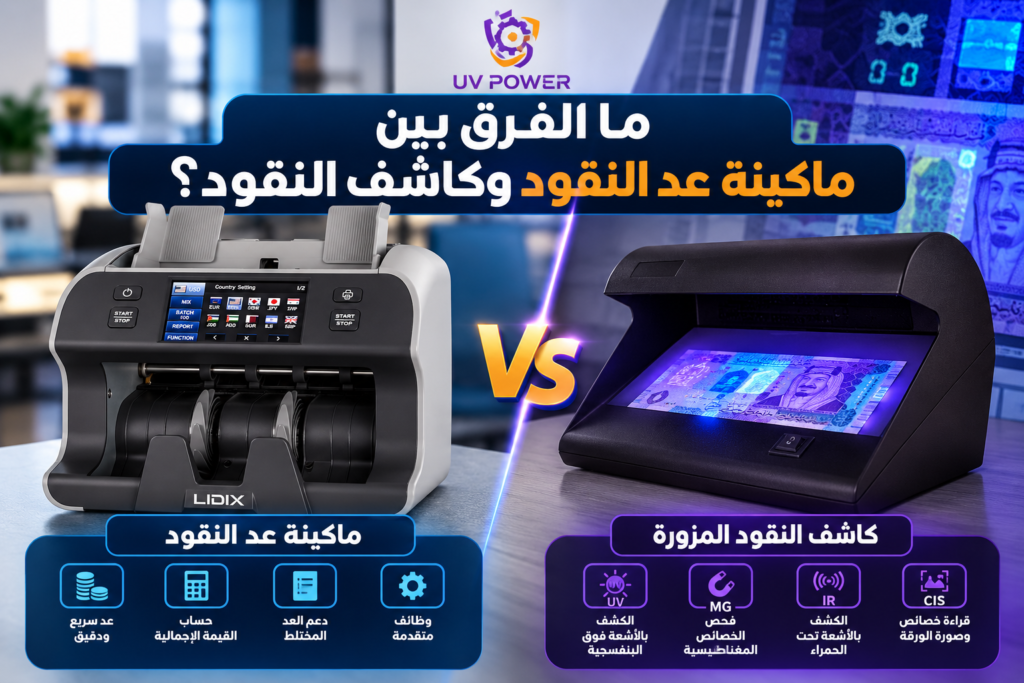
The difference in brief: A money counting machine counts notes quickly, while a counterfeit detector checks a single note without counting it. Examples from the UV Power store: the U-P10 checks a note with ultraviolet and magnetic detection only, the U-P100 counts without any checking, and the U-P200 combines counting and checking with UV, MG, and IR.
Choose a detector if you receive a few notes and want to check them one by one at the till. Choose a machine that combines counting and detection if you count stacks daily and want them checked in the same step.
Comparison table: money counting machine vs. counterfeit detector
| Comparison | Money Counting Machines | Counterfeit detector |
|---|---|---|
| Main function | Counting notes and organizing cash reconciliation | Banknote inspection |
| Note counting | Yes, it's the main function | Not the main purpose of most standalone detectors |
| Suspicious banknote detection | Available in some models | Main function |
| Mixed counting | Available on some advanced models | Not the main function |
| Typical use | Cash reconciliation and note counting | Checking notes when received |
In short: If you want to know the number of notes, you need a counting machine. If your main goal is checking notes, a counterfeit detector may suit you. If you need both functions, you can choose a machine that combines counting and detection.
What does a money counting machine do?
A money counting machine pulls notes through one by one, counts them, and shows the result on the display. Capabilities vary by model: some machines only do basic counting, while others offer additional functions.
These may include suspicious note detection, denomination recognition, mixed counting, total value calculation, and multi-currency support, depending on the machine's specifications.
To learn more about how it works, read:
How Does a Money Counting Machine Work? Counting and Counterfeit Detection Explained.
What does a counterfeit detector do?
A counterfeit detector checks specific features of banknotes to help verify them. The checking method depends on the type of device and the technologies it uses. Examples include the U-P10 counterfeit detector which checks the note with ultraviolet and magnetic detection.
Technologies used in some detectors and counting machines include:
- UV: ultraviolet light to examine specific note characteristics.
- MG: magnetic characteristic inspection.
- IR: infrared light to examine specific banknote characteristics.
- CIS: an image sensor used in some machines to read the note's image and characteristics.
To learn more about these technologies, see:
counterfeit detection technologies in money counting machines.
You can also see the
Saudi Central Bank's banknote security features
to learn about the official security features.
Do money counting machines detect counterfeits?
Yes, some money counting machines have systems that help detect suspicious notes during counting, but not every model has this function, and detection technologies and capabilities vary from machine to machine.
If this function matters to your business, don't rely on the words “counterfeit detection” in the product description; check the available detection technologies and the currencies the machine supports.
When do you need a counting-only machine?
A basic counting machine may be suitable if your main goal is knowing the number of notes and speeding up reconciliation, and you don't need advanced functions such as mixed counting or suspicious note detection.
The choice depends on your cash volume and the number of counts per day. If you handle large amounts or need to check notes during counting, it helps to compare machines that combine both functions.
When do you need a counterfeit detector?
A separate detector may be suitable when the priority is checking notes on receipt and you don't need to count large quantities continuously.
If you need to check notes and count large amounts of cash frequently, a machine that combines counting and inspection may be more suitable, depending on your work and the machine's specifications.
When to choose a machine that combines counting and counterfeit detection?
A machine that combines both functions can be a practical choice for businesses that handle cash daily and need faster reconciliation while checking notes during counting.
Examples of businesses that may benefit include:
- Shops and stores.
- Restaurants and cafés.
- Companies and offices.
- Businesses that reconcile cash frequently.
- Businesses that need to count and check notes in a single workflow.
Is mixed counting available on all machines?
No, mixed counting isn't available on every machine. This feature lets some advanced machines recognize different banknote denominations and calculate the total value, instead of just counting the notes.
If you need this feature, read:
What Is Mixed Counting in a Money Counting Machine, and How Does It Work?.
Which machine is right for shops and companies?
The right machine depends on how much cash your business handles, how you reconcile cash, and whether you need to detect suspicious notes or calculate the value of different denominations.
How do you choose the right machine for your business?
Before deciding to buy, answer the following questions:
- Do you need to count notes only, or check them too?
- How much cash do you handle daily?
- Do you need mixed counting and total value calculation?
- Does the machine support the Saudi riyal and the other currencies you use?
- Are the available detection technologies suitable for your needs?
- Are maintenance, spare parts, and technical support available?
Once you've defined these needs, you can compare machines without paying for features you don't need. For more details, see the
Money Counting Machine Buying Guide for Saudi Arabia.
UV Power money counting machines
UV Power offers money counting machines with functions and capabilities that vary by model. You can browse the available machines and compare their specifications to find the best option for your business.
Browse the money counting machines in the UV Power store.
Frequently asked questions
What is the main difference between a money counting machine and a counterfeit detector?
A counting machine focuses on counting notes and organizing cash reconciliation, while a detector focuses on examining banknote characteristics. Some machines combine these functions.
Do all money counting machines detect counterfeit notes?
No, detection technologies vary by model, and some machines are designed for basic counting only. Check the machine's specifications before buying.
What are the most common suspicious note detection technologies?
Common technologies include UV, MG, and IR, while some advanced machines use CIS sensors and additional inspection technologies.
Do I need two devices or one?
It depends on your work. If you need counting and detection together, a machine that combines both may be suitable. If the tasks are separate, using two devices may be practical.
Do all money counting machines support the Saudi riyal?
Supported currencies vary by model. Check support for the Saudi riyal and the currencies you need before buying.
Conclusion
A money counting machine differs from a counterfeit detector in its main function: the machine counts notes and helps organize cash reconciliation, while the detector focuses on checking notes for suspicious characteristics.
If you need both functions, you can compare machines that combine counting and detection. The right choice depends on your cash volume, the functions you need, supported currencies, and technical support availability.
Start by reviewing the
money counting machines available at UV Power
and choose the machine that suits your business needs.
