


Cash counting machines
How does the cash counting machine work? An explanation of the counting mechanism and the detection of counterfeiting
October
How does the cash counting machine work? An explanation of the counting mechanism and the detection of counterfeiting
The cash counting machine operates through a mechanical and electronic system that withdraws the banknotes and passes them one by one through the counting path, then calculates their number and displays the result on the screen. In some models, there are sensors and additional technologies that help examine the characteristics of the banknotes and detect suspicious ones.
The way the machines operate and their capabilities vary depending on the model; some are designed for a limited number of sheets, while others offer functions such as fraud detection, recognition of mixed categories, calculation of the total value, and support for multiple currencies.
In this guide from UV Power, we will learn about the mechanism of operation of the banknote counting machine, the role of the sensors, and how the banknote counting process differs from identifying its categories and examining its characteristics.
What is the cash counting machine?
The cash counting machine is an electronic device that helps count banknotes quickly, instead of counting them manually one by one.
The user places the sheets into the feeder unit, then the device’s mechanism pulls them out in a sequential manner. As they pass through the machine, the counting system records the passage of the sheets, and the result is displayed on the screen after the process is complete or stopped.
According to the model, additional functions may be available that help examine banknotes or identify their categories and calculate their value.
How does the cash counting machine work step by step?
1. Place the leaves in the feeding unit
The process begins by placing the set of banknotes in the dedicated feeding device. The banknotes must be arranged according to the manufacturer's instructions, avoiding placing folded or damaged banknotes that could obstruct their passage.
2. Pulling out the papers and passing them through the machine
The machine uses a mechanical mechanism to pull the sheets and pass them one after another through the counting path. The speed of the pulling and the design of the mechanism vary depending on the model.
3. Registration of the documents
As the sheets pass by, the counting system monitors their movement using sensors dedicated to this task. The device records the passage of the sheets to calculate the total count.
4. Examine the characteristics of the leaves in supported models
If the machine is equipped with detection systems, some banknote properties may be examined during its passage. The types of sensors and the inspection techniques used vary from one device to another.
5. Display the result on the screen
After the counting is complete, the machine displays the result. It may be limited to the number of ballots, or it may display additional information such as categories, total value, and test results, if the device supports these functions.
How does the machine know the number of banknotes?
The counting process relies on a sensor system that monitors the movement of the sheets within the device's path. When each sheet passes through, the system records the event within the counting process, then compiles the results to display the final count.
There are differences between models in the design of the sensors, the mechanism for pulling the sheets, and the method for detecting errors. Therefore, the way devices handle overlapping sheets or the passage of more than one sheet at a time may vary.
If the machine is prone to frequent errors or refuses to accept certain papers, there may be reasons related to the paper condition, the feeding method, the need for cleaning or maintenance of the device. You can read A guide to the reasons why the banknote counting machine rejects some banknotes To learn about this problem.
What role do the sensors play within the cash counting machine?
Sensors play an important role in operating a cash counting machine, but not all sensors are responsible for the same function. Some sensors are associated with the counting process and the passing of banknotes, while other sensors are used to check the properties of the banknotes.
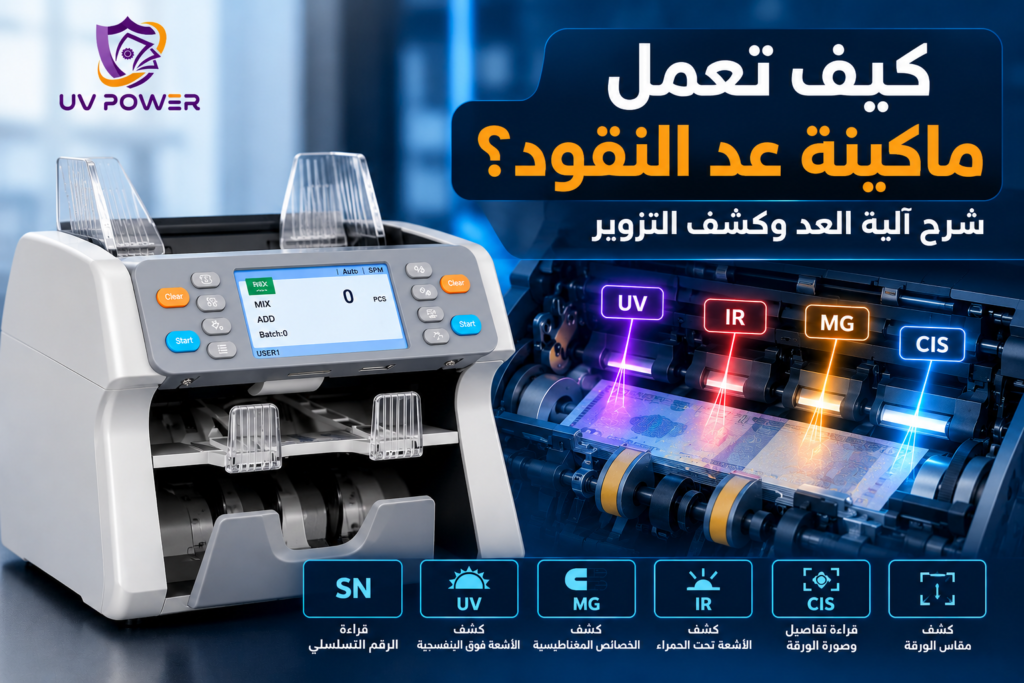
Some of the most common inspection techniques found in some machines are:
- UV — Ultraviolet rays: It is used to examine properties related to the paper's response to ultraviolet radiation.
- MG — Magnetic detection: It depends on examining the magnetic properties associated with some components of the banknote.
- IR — Infrared rays: It is used to examine the properties of the paper using infrared rays.
- CIS — Contactive Imaging Sensor: The device that uses this technology captures visual information about the paper, and an analysis of additional characteristics can be performed according to the system.
The presence of one of these technologies does not mean that the device includes the other technologies. Therefore, you should review the model specifications to see what sensors and functions are actually available in it.
For a comparison between the different screening techniques, read Technical guide for detecting fraud in cash counting machines.
How does the fraud detection feature work?
In machines equipped with detection functions, the paper passes through a system that examines specific characteristics using the technologies supported by the device. The system then compares the results with the standards or settings it has adopted.
The machine may use one technology or a combination of technologies, depending on its design and functions. When it detects characteristics that are inconsistent with the inspection standards, the device can issue an alert, stop counting, or reject the sheet, depending on the model.
When an alert appears, the paper should be removed and examined in accordance with appropriate procedures; the alert alone should not be considered conclusive evidence of the authenticity or forgery of the paper.
Also, the presence of a fraud detection feature does not mean that the machine can detect all types of fraud. The detection capabilities depend on the technology used, the currencies supported, the device settings and its condition.
What is the difference between UV, MG, IR, and CIS?
These techniques differ in the type of characteristics they examine, and the same function does not necessarily perform.
| Technology | Its general function | What needs to be verified |
|---|---|---|
| UV | Examining properties related to ultraviolet rays | The existence of the technology and how it is used in the model |
| MG | Examination of magnetic properties | The currencies and characteristics supported by the device |
| IR | Examining properties using infrared rays | Actual inspection capabilities of the model |
| CIS | Obtaining pseudo-image information about the sheet in supported devices | The functions in which the device uses image data |
Comparing the names of the technologies alone when buying a cash register is not enough; it is necessary to ensure how they are used and the functions they provide in the specific model.
What is the CIS technology in the cash counting machine?
CIS stands for Contact Image Sensor, and it refers to the contact image sensor. This technology is used in some machines to capture visual information about the banknote as it passes through the device.
Image data can be used in systems that recognize the characteristics of the paper or its category, depending on the design of the device and the software used. The functions provided by the CIS technology vary from model to model, so it should not be assumed that every device that contains them provides identical capabilities.
If you want to understand this technique in more depth, you can refer to An explanation of fraud detection techniques And reviewing the specifications of the device you are considering purchasing.
How does the machine work for mixed categories?
The basic counting machine differs from the mixed category counting machine. The basic device calculates the number of banknotes, while the device that supports mixed counting can recognize the supported categories and then calculate the total value of the amount according to its capabilities.
For example, if a set of cards contains different categories of Saudi riyals, the machine supporting this function analyzes the cards and identifies the categories that can be recognized, then displays the total value based on the results.
This function depends on the device's support for currency and the required denominations. It cannot be assumed that all cash registers can calculate the value of mixed banknotes.
To learn more, read What is the mixed counting in the cash counting machine? How does it work?.
What is the difference between counting the cards and calculating the value of the cash?
Count the sheets means calculating the number of sheets that passed through the device, regardless of the value of each sheet.
The calculation of the value of cash requires the device to be able to recognize the supported cash denominations, and then calculate the total value of them.
Therefore, if your goal is to know the number of banknotes only, a basic counting machine might be suitable. However, if you want to calculate the value of an amount containing different denominations, look for a device that supports mixed counting and calculation of the value of the currency you use.
Do all cash counting machines work the same way?
Coin counting machines share a basic principle: withdrawing the coins and passing them through the counting system. However, they differ in their internal design, counting speed, feed and output capacity, sensor technologies, and additional functions.
Some devices may limit counting of banknotes, while others provide detection of suspicious banknotes, recognition of denominations, calculation of the total value, or support for multiple currencies.
For this reason, the specifications of each model must be compared individually, rather than relying on a brand name or a general description such as «professional machine» only.
Why does the speed of cash counting machines vary?
The speed of the machine depends on the design of the device, the paper-pulling mechanism, and the internal control system. Some models may offer different levels of speed, while the capacity and the way the papers are handled vary from one device to another.
But speed is not the only criterion for selection. The daily workload, accuracy of counting, required testing techniques, currency support, ease of use and maintenance should also be considered.
What is the importance of cleaning and maintaining the cash counting machine?
Dust and paper remnants may accumulate within the counting path with continued use. The contamination of some parts can affect the passage of the sheets or the performance of the sensors, depending on the condition of the device and its design.
Cleaning according to the manufacturer's instructions helps to maintain the machine, but cleaning does not replace technical maintenance when recurring malfunctions or errors in counting occur.
To learn about the steps for caring for the device, read Manual for maintaining and cleaning a cash register machine.
How do you choose the right cash register?
After understanding how the device works, you can determine the specifications you need by answering the following questions:
- Volume of work: How many sheets do you need to count every day?
- Type of counting: Do you need to count the cards only or calculate the value of the mixed denominations?
- The fraud revealed: Do you need a device that supports techniques for examining suspicious documents?
- Currencies: Does the device support the Saudi riyal and other currencies that you use?
- Speed and capacity: Do they fit the amount of cash you deal with?
- Technical support: Is maintenance and spare parts available when needed?
You can browse A set of UV Power cash counting machines To compare the available options according to your needs.
And if you are at the stage of choosing the device before purchasing, you can also read Guide to buying a cash counting machine in Saudi Arabia.
Frequently Asked Questions about how the cash counting machine works
How does a cash counting machine calculate the number of banknotes?
The machine pulls out the sheets one by one, and the counting system records their passage through the track, then displays the final number on the screen.
Does every cash counting machine detect fraud?
No. The detection functions vary depending on the model. Some devices focus on counting, while others offer technologies to examine the characteristics of suspicious banknotes.
Do all machines have UV, MG, and IR?
No. The sensitivity and testing techniques vary from one device to another, so you should review the technical specifications of the model before purchasing.
What is the difference between a basic counting machine and a mixed counting machine?
The basic counting machine calculates the number of banknotes; the machine that supports mixed counting can recognize the supported denominations and calculate their total value according to its capabilities.
Can the cash counting machine recognize the Saudi riyal?
There are models that support the Saudi riyal, but you must verify the currencies and categories supported by the specific device before purchasing.
Does the cash register machine need periodic maintenance?
The machine requires care and cleaning according to the manufacturer's instructions. When repeated errors appear in the counting or sensors, it is preferable to have it inspected by a specialized entity.
The conclusion
The cash counter works by withdrawing the banknotes and passing them through the counting system, which records the passage of the banknotes and displays the final count. In some models, there are additional sensors and technologies for examining the characteristics of the banknotes, and there may also be features for identifying categories and calculating the total value.
The capabilities of the devices vary depending on the model, so it is not enough to just look at the speed alone when choosing. Compare the required functions, inspection techniques, supported currencies, feed capacity, and available maintenance.
You can start from Cash counting machine department at UV Power To learn about the available options and choose the device that suits the nature of your work.
