
money counting machine
What Are the Counterfeit Detection Technologies in Money Counting Machines? UV, MG, IR, and CIS Explained
October
In short: Money counting machines use four main counterfeit detection technologies, each checking a different feature of the note. UV checks how the paper responds to ultraviolet light, MG looks for magnetic ink, IR compares how inks behave under infrared light, and CIS captures an image of the note to recognize its denomination and features. Combining them is stronger than any single technology, because a counterfeit may pass one test and fail another.
Here we explain what each technology actually catches, its limits, and which UV Power models include each one.
If you're looking for a machine that combines counting and inspection, see the Money Counting Machine Buying Guide for Saudi Arabia to learn which specifications to compare before buying.
Why do money counting machines use more than one inspection technology?
Banknotes have various security features and markings, some of which can be checked with suitable sensing technologies. So some machines use multiple sensors to analyze a note as it passes through.
Combining inspection methods helps assess different note characteristics, and the machine may raise an alert if it detects a difference from its criteria. However, detection capabilities vary by model, currency, and software, and having one or more sensors doesn't guarantee detection of every type of counterfeit.
What are the most important techniques for detecting counterfeits?
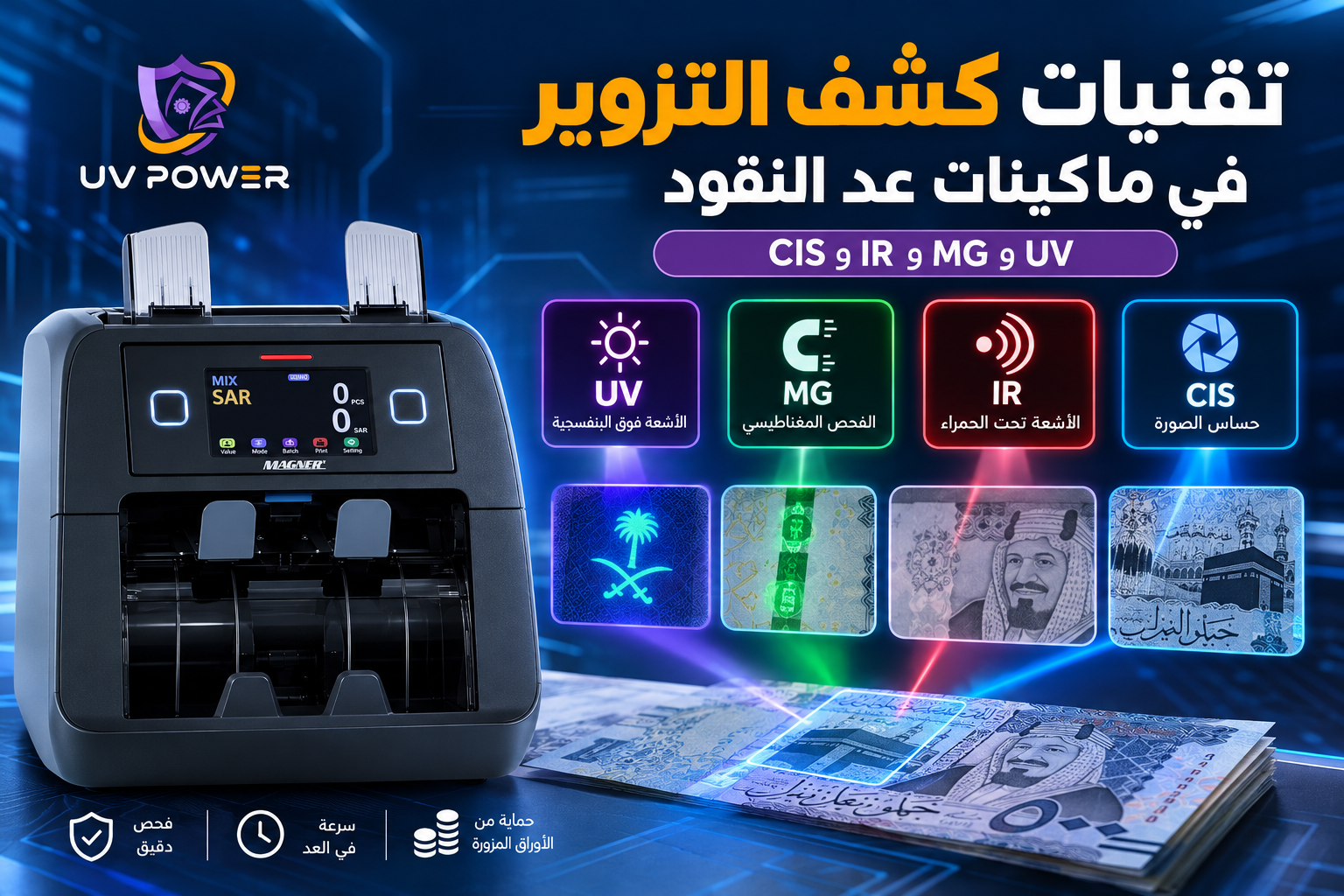
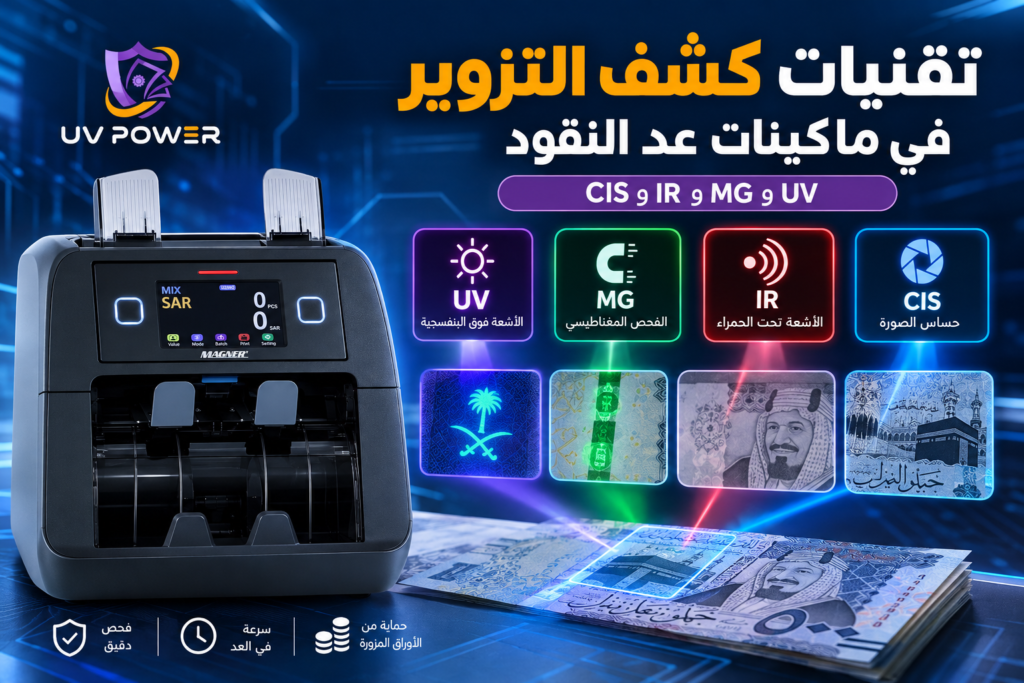
Common technologies in money counting machines include UV (ultraviolet), MG (magnetic inspection), and IR (infrared). Some advanced machines also use CIS technology, which reads the characteristics of the note's image.
1. UV technology: ultraviolet light
Genuine banknote paper is made of fibers that do not glow under ultraviolet light, and the note carries elements printed in fluorescent inks that appear only under it. The UV sensor detects any unexpected glow, which usually happens with bleached commercial paper.
Its weakness is that it does not catch counterfeits printed on unbleached paper, which is why it is used together with other technologies.
2. MG technology: magnetic inspection
Specific areas of a genuine note are printed with ink containing magnetic particles. The MG sensor passes over these areas, and if it does not find the expected signal, as with notes printed on office printers, it alerts the user.
If the machine detects a difference from its inspection criteria, it may raise an alert or stop counting, depending on its design and settings. MG is one of the inspection methods that can be combined with other technologies.
3. IR technology: infrared light
Genuine banknote inks behave under infrared light in a fixed pattern: some parts appear and others disappear. The IR sensor compares this pattern and catches notes that look identical to the eye but use different inks.
This technology can work together with UV, MG, and other sensors to provide multiple inspection methods. How IR is used and the level of inspection vary by manufacturer and model.
4. CIS technology: contact image sensor
CIS stands for Contact Image Sensor: a row of sensors that captures an image of the note line by line as it passes. In models with dual CIS, such as the U-P500, the note is read on both sides.
The image is used mainly to recognize the denomination and orientation of the note, which is what mixed denomination counting relies on, and it adds detection indicators by comparison with the supported denomination templates.
What is the difference between UV, MG, IR, and CIS?
| Technology | Inspection method | Possible role |
|---|---|---|
| UV | Ultraviolet light | Examining characteristics that respond to ultraviolet light |
| MG | Magnetic inspection | Examining supported magnetic characteristics |
| IR | Infrared light | Analyzing characteristics that respond to infrared light |
| CIS | Reading image characteristics | Helping analyze the note's image and identify its characteristics |
More technologies do not necessarily make a machine better for every use. What matters is how the model uses these technologies, the currencies it supports, and the functions you need. In our detailed CIS sensor explainer we explain what the sensor reads and what it does not.
Do UV, MG, and IR mean the machine detects all counterfeit notes?
No. Several inspection technologies can help check various banknote characteristics, but they don't guarantee detection of every type of counterfeit.
Inspection results vary by machine, currency, software version, recognition criteria, and the note's condition. So it's better to evaluate the inspection system as a whole rather than relying on a single sensor or the number of sensors.
Why does compatibility with the Saudi riyal matter?
If you use a money counting machine in Saudi Arabia, make sure the model supports the Saudi riyal and that its inspection functions and recognition criteria suit the currency and denominations you handle.
You can also refer to the Saudi Central Bank's banknote security features to learn the official security features of Saudi banknotes. To learn the riyal security features for each denomination, see our detailed guide.
Do counterfeit detection technologies differ from one machine to another?
Yes. Machines differ in the number of sensors, the technologies used, and how they analyze notes. Some models offer basic inspection functions, while others combine several technologies and advanced functions.
Why does software matter in detecting suspicious notes?
Inspection doesn't rely on sensors alone; software and recognition criteria play an important role in interpreting sensor data and comparing it with the machine's criteria.
What is the difference between counterfeit detection and denomination recognition?
Denomination recognition means identifying a note's denomination, such as 5, 10, 50, or 100 riyals, depending on the currencies and denominations the machine supports.
Meanwhile, the Counterfeit detection focuses on examining note characteristics for differences that might indicate it's suspicious, according to the machine's criteria.
Some machines may combine denomination recognition, suspicious note detection, mixed counting, and total value calculation, but make sure each function is listed in the model's own specifications.
Does an ordinary money counting machine have counterfeit detection?
It depends on the model. Some counting machines focus on counting notes, while other models offer inspection technologies such as UV, MG, or IR, and some advanced machines may include additional technologies.
When do you need a counting and counterfeit detection machine?
If your business handles cash frequently, combining counting and inspection in one machine may be practical. It depends on your cash volume, how you reconcile cash, and the level of inspection you need.
Stores, restaurants, cafés, companies, and businesses that handle large amounts of cash may benefit from these functions. See the Money Counting Machine Buying Guide for Saudi Arabia to determine the right specifications before buying.
How do you choose a machine with the right inspection system?
When comparing money counting machines, check the following:
- Inspection technologies: Check which technologies the model actually has.
- Currency support: Make sure the Saudi riyal and the other currencies you use are supported.
- Required functions: Decide whether you need basic counting, denomination recognition, mixed counting, or suspicious note detection.
- Software updates: Ask about updates and technical support for the model.
- Maintenance and spare parts: Make sure service and spare parts are available when needed.
You can browse the UV Power money counting machines section to compare the available models, then review the specifications of the machine that suits your work.
Which model suits those who need advanced inspection functions?
It depends on the functions you need and your workload. You can look at the U-P500 andU-P2000 and review each product's specifications to learn its actual counting, denomination recognition, and inspection capabilities.
| Model | UV | MG | IR | CIS |
|---|---|---|---|---|
| U-P100 | Counting only, no counterfeit detection | |||
| U-P200 | ✓ | ✓ | ✓ | — |
| U-P300 | ✓ | ✓ | ✓ | — |
| U-P500 | ✓ | ✓ | ✓ | ✓ (dual) |
| U-P2000 | ✓ | ✓ | ✓ | ✓ |
Source: product pages in the UV Power store at the time of writing.
Don't assume a model supports a specific technology or every currency just because it's advanced; rely on the published specifications of the specific machine.
To learn more about banknote inspection methods, also read How to Detect Counterfeit Money: Key Methods and Technologies.
Frequently asked questions about counterfeit detection technologies
What are the main counterfeit detection technologies in money counting machines?
Common technologies include UV, MG, and IR, and CIS is available on some advanced machines. Each technology's function varies with the machine's design and model.
What is the difference between UV and MG?
UV uses ultraviolet light to examine specific note characteristics, while MG examines supported magnetic characteristics.
What does IR do in a money counting machine?
IR uses infrared light to examine specific note characteristics and may work with other technologies to help analyze suspicious notes.
What is CIS in a money counting machine?
CIS stands for Contact Image Sensor, a technology that reads a note's image characteristics as it passes through the machine, and is used in some machines for recognition and inspection.
Does every money counting machine detect counterfeit notes?
No, detection functions vary by model. Make sure you know the machine's supported inspection technologies before buying.
Do multiple sensors mean a machine is better?
Not necessarily; what matters most is how the technologies are used in the machine and how well they suit the currency and the functions you need.
Can you rely on the machine alone to confirm a note is genuine?
The machine helps check notes and detect differences according to its criteria, but it shouldn't be your only means of handling suspicious cases. In important cases, follow appropriate verification procedures and refer to official sources.
Conclusion
Money counting machines use a range of inspection technologies, the most common being UV, MG, IR, and CIS. Each has a different function, and some machines combine them to provide multiple ways of analyzing banknotes.
When choosing a machine for the Saudi market, don't focus only on the number of sensors; check Saudi riyal support, available functions, inspection criteria, and the availability of updates and maintenance.
You can browse the UV Power money counting machines and compare machine specifications to choose the model that suits your business.