


money counting machine
Money Counter for Sweet Shops: Get Ready for Eid Night and the Hajj Season
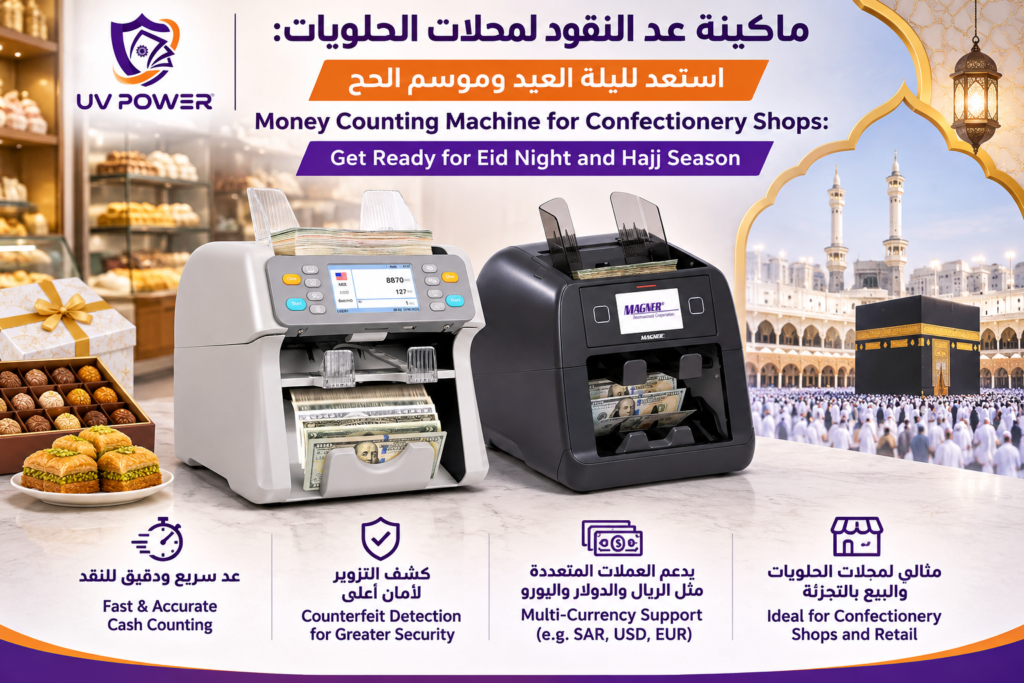
Nov
Eid night in a sweet shop has a rhythm unlike the rest of the year. Pre-booked orders go out one after another, customers at the counter want a box of maamoul or a tray of basbousa before it sells out, and the phone keeps ringing with hospitality orders. The owner is busy with production and packing; the cashier is busy with speed. At the end of the night there is a full drawer, large notes that came with large orders, and a question nobody likes to ask: are all these notes genuine, and does the total match the invoices?
This article is for sweet shop owners, factory managers and branch accountants: how to choose a money counter for a sweet shop, how to handle cash during Eid and Hajj without discovering weak procedures in the middle of the season, and which device really fits the size of your shop.
Three seasons, three different problems
Not every peak is the same. We do not have documented figures for how much sales rise in each shop, but the nature of each season is clear:
- Eid al-Fitr: The last days of Ramadan and Eid night are the busiest. Many transactions in a short time, and pre-booked orders paid on collection.
- Eid al-Adha: Hospitality orders and family gifts, many of them large orders of several boxes.
- Hajj season: In Makkah, Madinah and nearby cities, visitor traffic and orders from offices and hospitality providers. And if your shop really does receive currencies other than the riyal, that is an extra challenge.
What they have in common: a sudden surge of cash in a shop used to a calmer pace, and staff busy serving customers more than checking notes.
Where is your profit at risk?
A large order paid with a counterfeit note
A sweet shop's margin is spread across ingredients, production, packaging and labour. When a SAR 400 hospitality order is paid with a fake SAR 500 note, the shop has lost SAR 400 of sweets and SAR 100 of genuine change. The full loss is SAR 500, the profit of several other orders.
Large orders are the most likely to be paid with large notes, and they are most often received at the busiest times.
Late closing after a long night
After Eid night, the drawer is counted very late or left until the morning. The later the count, the harder it is to know where a difference came from and when.
Cash handover between shifts
Shops that open long hours in the season add a shift or split the working day. Every handover without a clear figure in front of both sides opens the door to disputes.
What does a sweet shop really need?
Before choosing a device, separate four needs:
| Need | When it happens | What solves it |
|---|---|---|
| Checking the note before completing the sale | At the cashier, during the rush | A standalone detector such as the U-P10 |
| Knowing the drawer's value quickly and accurately | At closing and shift handover | A money counter with detection sensors |
| A figure the customer can see on a large order | When a large sum is received in front of him | A money counter + external display |
| A record for each branch or shift | In central accounting | Software or a report printer |
The difference between counting and counterfeit detection matters here. A counter with detection sensors checks notes during the count, after the customer has already taken the order. Checking at the cashier happens before that. So in a shop that receives SAR 500 notes, one does not replace the other. The full explanation is in The difference between a money counter and a counterfeit detector.
Choosing a device by shop size
One shop with one cashier
If the closing count is done after sorting notes by denomination, you can rely on the U-P300: it counts notes and calculates the value of each denomination separately, checks with UV, magnetic and IR sensors, has a 600-note hopper and a two-year warranty direct from UV Power. Add a U-P10 at the cashier to check large notes.
A busy shop with several cashiers or shifts
Here mixed denomination counting is what shortens closing time. U-P500 counts drawers without sorting and gives the count of each denomination and the total, checking with dual CIS, IR, MG, MT and UV sensors, with a 3-year warranty. It has a single pocket, so it stops at a rejected note until it is removed. How this function works is explained in Mixed counting.
And if your shop only takes Saudi riyals, the Lite counts L1 is a more economical alternative: mixed denomination counting with a total value, CIS, IR, MG, MT and UV sensors, a colour touchscreen, a 300-note hopper and a two-year warranty direct from UV Power. For shops in Makkah and Madinah that receive other currencies during Hajj, the U-P500 is a better fit.
Large orders paid in front of the customer
A customer paying a large sum wants to see the count himself, and counting by hand in front of him is slow and awkward. The U-P500 with the compatible the external display shows the result to the customer on a clear LED display, so the figure is settled on the spot.
A sweets factory with branches
An accountant receiving the takings of several branches needs speed and a record. U-P2000 sends rejected notes to a separate pocket and keeps counting, with mixed counting, the same sensors and a 3-year warranty. And the Counting Management Software saves the results of every count and the serial numbers, and exports PDF and Excel reports for each branch or day.
Shops in Makkah and Madinah during Hajj
If your shop really does receive currencies other than the riyal, do not assume any multi-currency counter will do. The U-P500 and U-P2000 support 20 currencies according to their product pages, but what matters is the specific currencies you receive. Check them before buying, as explained in multi-currency money counter.
Getting the shop ready before the season: a short list
- Test the counter on real drawers at least two weeks before the season.
- Decide who counts the drawer, when, where, and how the receiver signs.
- Train new cashiers to check SAR 100 and SAR 500 notes. The guide is in security features of the Saudi riyal.
- Agree on a rule: every SAR 500 note is checked before change is given.
- Do not postpone the Eid-night count until after Eid.
Objections from shop owners
“I don't want to slow customers down by checking every note”
You don't need to check every note. Check the large denominations only. Checking one note on a U-P10 takes moments, far less than the time spent hunting for a difference at the end of the night.
“The heavy trade is only a few days a year”
True, but those few days are when a large part of the year's profit is made. Still, choose the device for your real size: a small shop does not need a two-pocket counter.
“The counter is expensive compared with what I lose”
Work it out with your own numbers: daily closing time, the number of discrepancies, and the value of one counterfeit note on a large order. The method is in the cost of manual cash counting.
Frequently asked questions
Which counter suits a small sweet shop?
The U-P300 if you sort notes by denomination before counting, or the U-P500 if drawers are mixed and time is short. Add a detector at the cashier.
Do I need an external display?
It helps if you count large sums in front of customers on pre-booked or hospitality orders, because it shows them the figure directly. For internal closing you do not need it.
Does a money counter detect counterfeit notes during the rush?
The counter detects during counting, which is after acceptance. In the rush, the real protection is checking large notes at the cashier before giving change. And no device guarantees detecting every type of counterfeit.
How do I organise cash handover if I add a shift in the season?
Count the drawer at every handover in front of both sides, and print or save the result. The full procedure is in cash handover between shifts.
What warranty do these devices have?
The U-P500 and U-P2000 carry a 3-year warranty direct from UV Power; the U-P300 and U-P10 carry two years.
Conclusion
For Eid and Hajj you prepare your sweet shop for production and orders. Complete the preparation with a way to protect what you collect:
- Check before selling: U-P10 counterfeit detector.
- Small shop: U-P300.
- Busy shop and large orders in front of the customer: U-P500 with the external display.
- Factory and branches: U-P2000 with Counting Management Software.
Message us on WhatsApp with the number of cashiers and your shop's busiest season, and we will recommend the right device before the next season.
