


money counting machine, Professional money counting machines
Banknote Sorting Under Saudi Central Bank Instructions: Dates, Fitness Levels and Machine Requirements
Nov
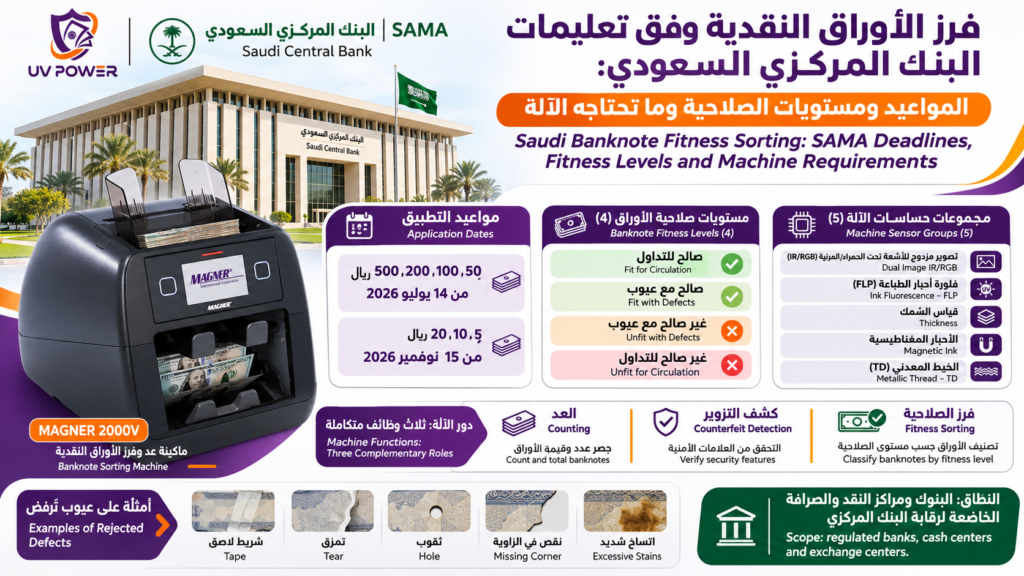
The Saudi Central Bank (SAMA) issued the “Technical Sorting Instructions for the Sixth Edition of Saudi Banknotes” under Circular No. 472057608 dated 21/5/2026. The instructions define when a banknote is fit for circulation, which defects are allowed, and which sensors counting and sorting machines must have.
This article is a simplified summary of the instructions and does not replace the official text in the SAMA Rulebook.
Who do the instructions apply to?
The instructions apply to “financial institutions”, defined as: banks, cash centers and money exchange centers that count and sort Saudi banknotes and are supervised by the Central Bank.
Shops, restaurants and companies that count their cash for deposit are not included in this definition. However, the cash you deposit will go through this sorting at the bank, which is reason enough to understand the criteria.
Effective dates
| Denominations | Effective from |
|---|---|
| SAR 50, 100, 200 and 500 | 29/1/1448 AH (14/7/2026) |
| SAR 5, 10 and 20 | 5/6/1448 AH (15/11/2026) |
In other words, the instructions now apply to all sixth-issue denominations.
The four banknote fitness levels
Article 9 divides banknote fitness into four levels:
- Fit for circulation.
- Fit for circulation with some defects.
- Unfit for circulation with some defects.
- Unfit for circulation.
Examples of each level for every denomination are shown in images in Appendix 1 of the instructions.
When is a banknote rejected?
Article 4 requires sorting to be done by counting and sorting machines, that the banknote is not counterfeit, that it is free of large holes, tears, missing or folded parts and adhesive tape, and that its soiling does not exceed the permitted limit.
Technical limits for material defects (Article 6)
| Defect | Limit |
|---|---|
| Length | ± 4 mm |
| Width | ± 2 mm |
| Torn area | ≤ 20 mm² |
| Tear length | ≤ 0 (as stated in the text) |
| Missing corner area | ≤ 200 mm² |
| Folded corner area | ≤ 150 mm² |
| Holes | ≤ 7 mm² |
| Adhesive tape | Not allowed |
Stains, writing and marked banknotes (Article 8)
- Stains: A banknote with a stain larger than 15 mm × 15 mm is not accepted.
- Writing and drawings: A banknote with writing or drawings on the King's portrait area, whether printed or in the watermark, is not accepted. A banknote soiled by writing is classified as unfit for circulation.
- Marked banknotes: These are banknotes stained by security ink released by self-destruct (ink-staining) devices in cash-in-transit cases or ATM cassettes. They may not be accepted or circulated, and must be handed directly to a Central Bank branch.
Soiling (Article 10)
Soiling is measured as the average “optical density” at specified points on both sides of the banknote. Each denomination has its own limit; if the average reaches it, the banknote is not returned to circulation:
| Class | Front | Back |
|---|---|---|
| SAR 5 | ≥ 0.21 | ≥ 0.20 |
| SAR 10 | ≥ 0.22 | ≥ 0.23 |
| SAR 20 | ≥ 0.21 | ≥ 0.23 |
| SAR 50 | ≥ 0.12 | ≥ 0.14 |
| SAR 100 | ≥ 0.26 | ≥ 0.31 |
| SAR 200 | ≥ 0.18 | ≥ 0.17 |
| SAR 500 | ≥ 0.19 | ≥ 0.18 |
These values are programmed into the machine and cannot be judged by eye.
Sensors required in counting and sorting machines
Article 14 requires every machine to include the following sensors:
| Sensor | Function |
|---|---|
| Dual image sensor (IR and RGB) | Detecting soiling, stains, writing and drawings |
| Ink sensor (FLP) | Detecting fluorescence and phosphorescence |
| Thickness sensor | Detecting tape, tears, wear and holes |
| Magnetic (ink) sensor | Magnetic properties of the ink |
| Metal thread (TD) | Magnetic properties of the metal thread |
For counterfeit detection, Article 5 requires the machine to verify magnetic threads, magnetic serial numbers, infrared-reactive inks and phosphorescent features. For an explanation of these technologies, see counterfeit detection technologies in money counting machines.
Speed classes in the instructions
- High-speed machines: about 20–30 notes per second.
- Medium-speed machines: about 10–15 notes per second.
How does the Central Bank verify compliance?
The Central Bank randomly draws 35,000 to 50,000 sorted banknotes and extracts a “standard sample” of 315 notes from them. Three defect levels are then applied:
| Level | Defect | Limit in the sample (315 notes) |
|---|---|---|
| Level 1 (critical) | Counterfeit or suspected counterfeit | Zero, with an immediate report on each case |
| Level 2 (major) | Stains, tears, writing and drawings | No more than 14 notes |
| Level 3 (minor) | Soiling | No more than 21 notes |
Article 16 states that the Central Bank approves the programming of counting and sorting machines at financial institutions and visits their premises to verify implementation. Institutions are responsible for ensuring that suppliers and manufacturers set up the machine programming, and for following manufacturer updates.
Counting, sorting and fitness sorting: what is the difference?
- Counting: How many notes, and what are they worth?
- Counterfeit detection: Is the banknote genuine?
- Fitness sorting: Is its condition good enough to return it to circulation?
The instructions mainly concern the third type, while also requiring the second. A regular counting machine with counterfeit detection does not measure soiling by optical density. For the difference between machines that check condition and those that don't, see Banknote fitness sorting: Magner 2000V or 2000F.
What does this mean for you in practice?
- If you are a bank, cash center or money exchange: Ask the supplier for proof that the machine has the five sensors listed in Article 14, that soiling limits can be programmed for each denomination, and that updates are provided when changes are issued. Remember that approval of the programming rests with the Central Bank.
- If you are a shop or company that deposits its cash: You are not within the stated scope of the instructions. But torn, taped or written-on notes will be sorted out at the bank, so it helps to set them aside from the start. A note rejected for its condition is not necessarily counterfeit.
Frequently asked questions
Do the instructions require shops to buy a sorting machine? Their stated scope is banks, cash centers and money exchange centers supervised by the Central Bank.
Do they cover earlier issues? The instructions define “Saudi banknotes” as the sixth issue.
What should I do with a banknote that has coloured ink stains? It may be “marked” with security ink. The instructions prohibit financial institutions from accepting such notes and require them to be handed to a Central Bank branch.
Can a regular machine detect the level of soiling? The instructions require optical density to be measured with a dual image sensor (IR and RGB). Check any machine's specifications before assuming it can.
Source: Technical Sorting Instructions for the Sixth Edition — Saudi Central Bank (SAMA) Rulebook.
Need a sorting machine recommendation for your institution? Message us on WhatsApp with your type of organization and daily cash volume.
Read also: Updating your money counter for riyal denominations · security features of the Saudi riyal · Money Counting Machines for Banks and Cash-in-Transit Companies · money counting machine for exchange companies
