


money counting machine, Professional money counting machines
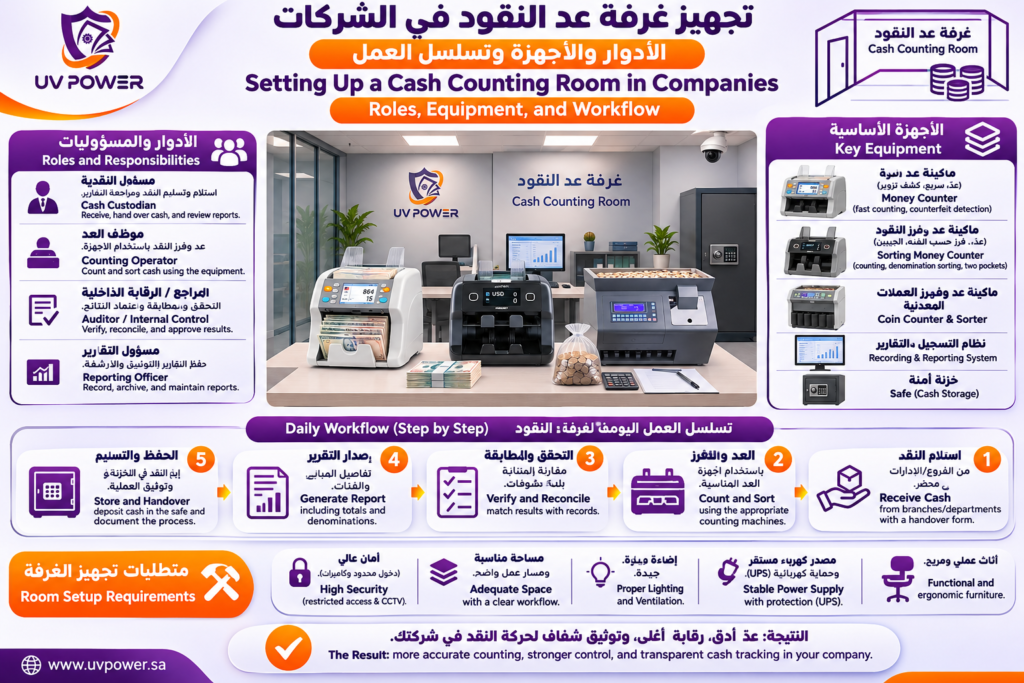
Setting Up a Cash Counting Room: Roles, Equipment and Workflow
Nov
When cash from several branches or tills arrives in one place, putting a money counting machine on a desk is not enough. Errors here rarely come from the machine; they come from mixed-up bags, missing records, or one person handling receiving, counting and reconciliation alone.
This guide explains how to organize a counting room: who does what, in what order, and which machines suit each stage.
When do you need a dedicated counting room?
You probably need one if one or more of the following applies:
- You receive cash from more than one branch or till every day.
- You hand cash over to a cash-in-transit company or the bank in prepared bundles.
- More than one employee counts cash at the same time.
- You need later proof of what was counted (for audits or disputes over an amount).
A single shop that counts its till at the end of the day only needs End-of-day cash drawer count.
The three roles
| Role | Responsibility | Does not |
|---|---|---|
| Receiver | Receives the bags and records each bag number and declared amount | Open the bags |
| Counter | Opens one bag at a time and counts it on the machine | Change the declared amount |
| Reviewer | Matches the counted amount against the declared amount and approves differences | Count the bag they are reviewing |
In a small room one person may hold two roles, but ideally the same person should not both count and approve differences. Many companies require two people to be present during counting.
The workflow, step by step
- Receiving: Record each bag: source (branch or till), date, seal or bag number, and declared amount.
- Opening: Only one bag on the counting table; do not open the next one until the previous one is closed out.
- Preparation: Remove staples, clips and bands, and flatten folded notes.
- Counting and sorting: Count the cash in mixed counting mode to get the total value and the denomination breakdown. Rejected notes are checked by hand and recorded separately.
- Coins: Counted on a separate machine, if any.
- Reconciliation: Counted versus declared. Any difference is recorded and signed off by the reviewer.
- Preparing for deposit: Fixed-count bundles using the Batch function. Details in Preparing cash bundles.
- Reporting: Keep the result for each bag (printed or exported) with the names of the counter and the reviewer.
Machines by stage
| Stage | What you need | Examples from our store (per their product pages) | Warranty (per the product page) |
|---|---|---|---|
| Mixed cash counting | Mixed-denomination counting and total value with counterfeit detection | U-P500, U-P2000 | 3 years each |
| Non-stop counting | Two pockets: one for counted notes, one for rejects | U-P2000, Magner 2000V | U-P2000: 3 years · Magner 2000V: 2 years |
| Heavy-duty and bank use | Heavy duty and mixed-currency counting | Magner 2000V, Magner 2000F, Lidix CL-2 | 2 years each |
| Fitness sorting | Rejects torn, folded and taped notes | Magner 2000F | Two years |
| Coins | Counting and sorting Saudi coins | U-P1000 | Two years |
| Documentation | A report printer, or software to save records and serial numbers and export them | U-P500/U-P2000 printer, Magner 2000V/F printer | 2 years for each printer |
When do you need fitness sorting? When you hand cash to an organization that does not accept damaged notes. Details in Magner 2000V or 2000F, and the official standards for banks in Banknote sorting under Saudi Central Bank instructions.
Room size and number of machines
Small room
One mixed counting machine, a coin machine if needed, and a printer or reporting software. The counter and the reviewer are two different people, even if the reviewer is part-time.
Medium or large room
More than one machine, for two reasons:
- Continuity: If one machine breaks down, work does not stop.
- Independent recount: If a result is in doubt, it is recounted on another machine.
You can split the roles: one machine for mixed counting, and another with fitness sorting for cash that goes to the bank.
Location and environment
- A fixed spot for each machine, because moving it often increases dust on the sensors.
- A separate table for sealed bags and another for counted cash, so the contents of two bags never mix.
- Camera coverage of the opening and counting area, according to your company policy.
- An external display if the reviewer or receiver sits facing the counter. Our store offers displays compatible with U-P500, U-P2000 and Magner 2000V/F.
Documentation and reports
Each bag has a record with: source, declared amount, counted amount, denomination breakdown, rejects, difference, names of the counter and reviewer, and time.
If the machine can save serial numbers and export results, this saves a lot of work when a dispute arises. See money counter software andSerial number reading.
Common mistakes in counting rooms
- Opening more than one bag on the same table.
- Putting rejected notes back into the bundle without checking them.
- Covering a difference with cash from another bag.
- No written record, relying only on the machine's display.
For the general principles of cash control, see Cash control.
Frequently asked questions
Do I need a fitness sorting machine in every counting room? No. You need one if the organization receiving your cash requires notes in good condition. For counting deposits, a mixed counting machine with counterfeit detection is enough.
Two pockets or one? With large volumes, the second pocket lets the machine keep counting without stopping. The difference is explained in Two-pocket vs one-pocket money counters.
Which machine should I choose for coins? For a comparison, see Coin counting machine: U-P400 or U-P1000.
Planning a counting room? Message us on WhatsApp with your number of branches and daily cash volume, and we will recommend the machines.
Read also: Professional Money Counting Machines for Companies and Banks · Money Counting Machines for Banks and Cash-in-Transit Companies
