


money counting machine
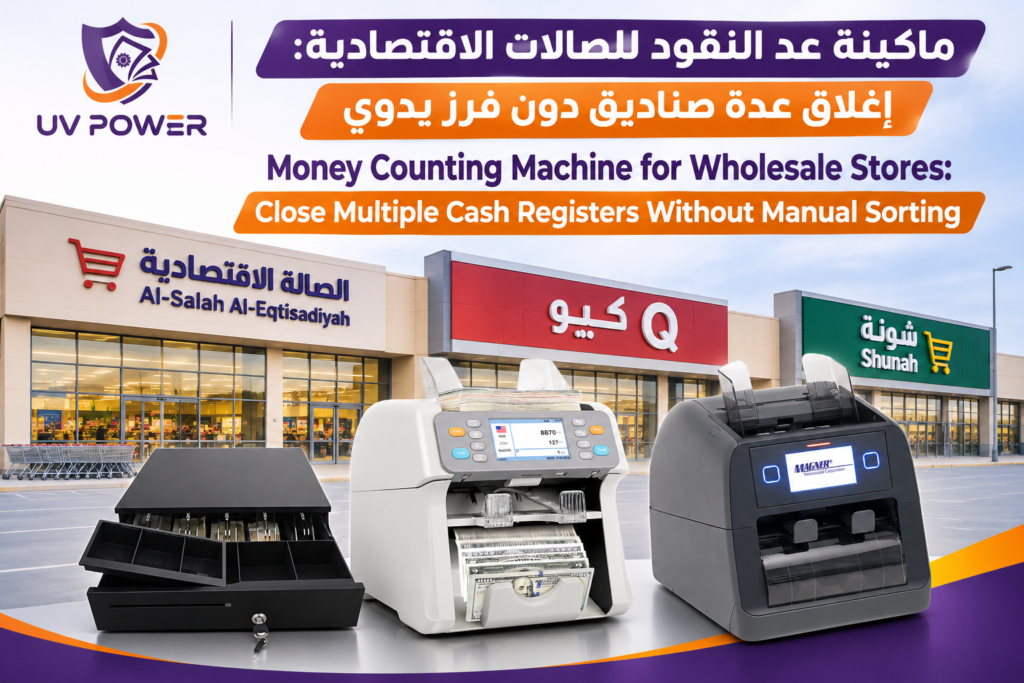
Money Counter for Discount Food Stores: Close Several Tills Without Hand-Sorting
Nov
It is nearly midnight and the store has closed. In front of the manager are four drawers, each holding hundreds of SAR 5, 10 and 50 notes, mixed with change and halalas. Every cashier is waiting to know their drawer balance before leaving, and the manager wants one figure to match against the POS report. At this point the question is not "Do we need a money counter?" but "Why are we still counting all of this by hand?"
The short answer: a money counter for discount stores is usually a mixed denomination counter that gives the drawer total by value in a single pass, backed by a simple counterfeit detector at the checkout for large notes. The size and type of machine depend on the number of tills and the amount of cash, not on the price tag.
Why is cash in a discount store different?
A discount food store sells low-priced goods to a large number of customers. That creates a distinct cash pattern:
- Many small invoices: thousands of small transactions mean the drawer fills with small-denomination notes, not a few large ones.
- Mixed denominations in every drawer: cashiers do not sort notes during peak hours; each note goes wherever there is room.
- Constant change and halalas: giving change to many customers makes coins a permanent part of the closing count.
- Several tills and points of sale: each till is a separate float that must be reconciled on its own.
- Short, sharp peaks: the end of the month, the start of the week, before Ramadan and Eid, and the minutes before closing.
This pattern means the problem is not just the "amount of money" but the number of notes and how many denominations there are. SAR 100 in SAR 5 notes is twenty notes; SAR 100 in a SAR 100 note is one. Hand counting gets tiring because of the number of notes, not their value.
Where do minutes and riyals get lost at daily closing?
1. Sorting before counting
Before counting by hand, the employee sorts notes into piles by denomination, counts each pile, then multiplies and adds. Three steps per drawer, and each step is a chance for error.
2. Recounting whenever there is a difference
If a SAR 10 difference appears, the count starts over. In a store with four tills, recounting may happen more than once in the same night while staff wait.
3. Undocumented handover
When a drawer is handed over without a clear figure agreed by both sides, it becomes hard later to know when a difference appeared and who is responsible. That is where friction between staff and management begins.
4. A counterfeit note in the rush
At peak time, dozens of customers pass the cashier within minutes. If a customer pays a SAR 30 bill with a counterfeit SAR 100 note, the loss does not stop at the note: the store handed over SAR 30 of goods and gave SAR 70 in genuine change. The real loss is SAR 100 out of the store's own money, plus the time spent investigating a difference whose cause will only be understood if the note is found.
Why are hand counting and cashier experience not enough?
An experienced cashier is great at serving customers, but experience does not prevent fatigue after hours of work, nor does it make counting five hundred small notes any faster. And a hand cannot detect a difference in ink that only shows under ultraviolet light, or a magnetic mark that cannot be felt.
More importantly, hand counting leaves no trace. A machine that shows the drawer total on screen, or prints it on paper, turns the figure into a reference both sides agree on before the cashier leaves. If you want to calculate the cost of hand counting with your own store's figures, there is a detailed method in our article on the cost of manual cash counting.
Which functions does the store actually need?
Before choosing a device, separate these five different needs:
| Need in the store | Required function | Where to find it at UV Power |
|---|---|---|
| Knowing the full drawer value without hand-sorting | Mixed denomination counting and total value | U-P500 or U-P2000 |
| Not stopping the count at every rejected note | A separate pocket for rejected notes | U-P2000 with two pockets |
| Checking a large note before giving change | A standalone counterfeit detector at the checkout | U-P10 with ultraviolet, magnetic detection and a magnifier |
| Counting halalas and riyal coins | Counting and sorting of coins | U-P400 for the new Saudi riyal coins |
| A closing slip signed by both sides | A compatible report printer | U-P500 and U-P2000 report printer |
Mixed denomination counting is the function that changes daily closing in a discount store, because it removes the sorting step. You load the notes as they are; the machine recognises each note's denomination and gives the count and value per denomination plus the total. The full explanation of this function is in our article on Mixed counting.
Keep in mind that counting and counterfeit detection are two different things. Money counters with sensors such as UV, MG and IR check notes while counting, but they work in the back office after the note has already been accepted. Checking at the checkout happens before change is given, so its role is different. The difference is explained in our article money counter vs. counterfeit detector.
Which device suits the size of your store?
A store with one or two tills and moderate cash flow
If closing is done after sorting notes by denomination, you can rely on the U-P300: it counts notes and calculates the value when the batch is a single denomination, checks with ultraviolet, magnetic and infrared detection, and its hopper holds 600 notes. However, it does not count mixed denominations, so hand-sorting before counting remains.
If time is the main problem, moving to a mixed denomination counter removes the sorting step entirely.
A store with three or more tills
Here U-P500 becomes the logical starting point: mixed denomination counting and total value, a colour touchscreen showing details for each denomination, dual CIS, IR, MG, MT and UV sensors, serial number reading, a 600-note hopper and a 3-year warranty directly from UV Power. It is a single-pocket machine, so if a note is rejected the count stops until it is removed.
And if your store only takes Saudi riyals and drawers are medium-sized, the Lite counts L1 is a more economical choice: mixed denomination counting with a total value, CIS, IR, MG, MT and UV sensors, a colour touchscreen, a 300-note hopper and a two-year warranty direct from UV Power. The main difference from the U-P500 is that it is dedicated to the Saudi riyal only.
If peak-time drawers contain many worn notes that get rejected, or you want counting to continue without stopping, U-P2000 adds a second pocket for rejected notes with almost the same functions and a 3-year warranty. The difference between one and two pockets is explained in our article Two-pocket vs one-pocket money counters.
A store with several branches or a central accountant
When the accountant needs a record of every count to refer back to later, U-P500 or U-P2000 can be used with the Counting Management Software that stores count results and serial numbers and exports reports as PDF and Excel. If paper is better for signing at handover, the compatible printer prints the note count, denominations and total value.
Don't forget the halalas
If coins take time at your closing, U-P400 is designed to count the new Saudi riyal coins and sort them into pockets by denomination, giving the count and value, and it rejects non-Saudi and fake coins. It is compared with U-P1000 in our article on the Coin counting machine.
Objections we hear from store owners
"My cashier is experienced and never makes mistakes"
That may be true in the morning. But closing happens at the end of the shift, after hours on their feet. The machine does not replace the cashier; it gives them, and you, a figure nobody can dispute.
"My cash sales are not that large"
If a drawer is counted in a few minutes without differences, a counterfeit detector at the checkout with a simple machine such as U-P300 may be enough. Do not buy a mixed denomination counter if your drawers do not need one.
"The machine has counterfeit detection, so I don't need a device at the checkout"
The back-office machine finds a suspect note after it has been accepted and change has been given. A checkout device allows checking before that. The two functions complement each other in a store that receives SAR 100 and 500 notes. No device detects every counterfeit note with absolute certainty, so staff familiarity with security features remains part of the procedure; you will find them detailed in our article on the security features of the Saudi riyal.
A suggested closing procedure for a store with several tills
- Each cashier prints the POS report before counting, so the count is not influenced by the expected figure.
- The whole drawer is loaded into the machine in mixed denomination mode.
- Rejected notes are removed and checked by hand, then recounted or recorded separately.
- The machine total is compared with the report, and the cashier and the receiver both sign the figure.
- Coins are counted separately and the two figures are added.
The full template for this procedure is in our article on the End-of-day cash drawer count.
Frequently asked questions
Does a discount store need a money counter even with the spread of electronic payment?
It depends on the share of cash in your own sales. If your drawers fill with small-denomination notes every day, counting time and differences determine the need, not the share of electronic payment in the market as a whole.
What is the difference between U-P300 and U-P500 for a discount store?
U-P300 calculates the value when notes are a single denomination, so it needs hand-sorting before counting. U-P500 counts mixed denominations and gives the drawer total directly, and adds a CIS sensor and serial number reading.
Does a money counter detect every counterfeit note?
No. The machine checks notes with the sensors listed in its specifications and rejects what does not match, but no device guarantees detection of every type of counterfeit. Make checking at the checkout and counting in the office two complementary steps.
Do I need a machine for every till?
Usually not. Closing is done in one place, so one machine in the manager's office is enough for several tills, while a small counterfeit detector sits at each checkout that receives large notes.
What about warranty and maintenance?
U-P500 and U-P2000 come with a 3-year warranty directly from UV Power, and U-P300, U-P400 and U-P10 with a 2-year warranty. Simple daily care extends the life of the device, as explained in our article on money counting machine maintenance.
Conclusion: make closing a figure nobody disputes
A discount store profits from a high number of transactions, and that same volume is what makes manual closing slow and prone to differences. Start by working out how many tills you have and how many notes are in each drawer, then choose:
- Checking before accepting: U-P10 counterfeit detector at every checkout that receives large notes.
- Faster closing for several tills: U-P500 for mixed denomination counting and totals.
- Counting without stopping at rejects: U-P2000 with two pockets.
- Lots of halalas: U-P400 for coins.
Need help choosing? Message us on WhatsApp with the number of tills and what your drawers look like at closing, and we will recommend the right setup for your store.
