


money counting machine
Money Counter Specifications: How to Read Every Line of the Spec Sheet Before You Buy
Nov
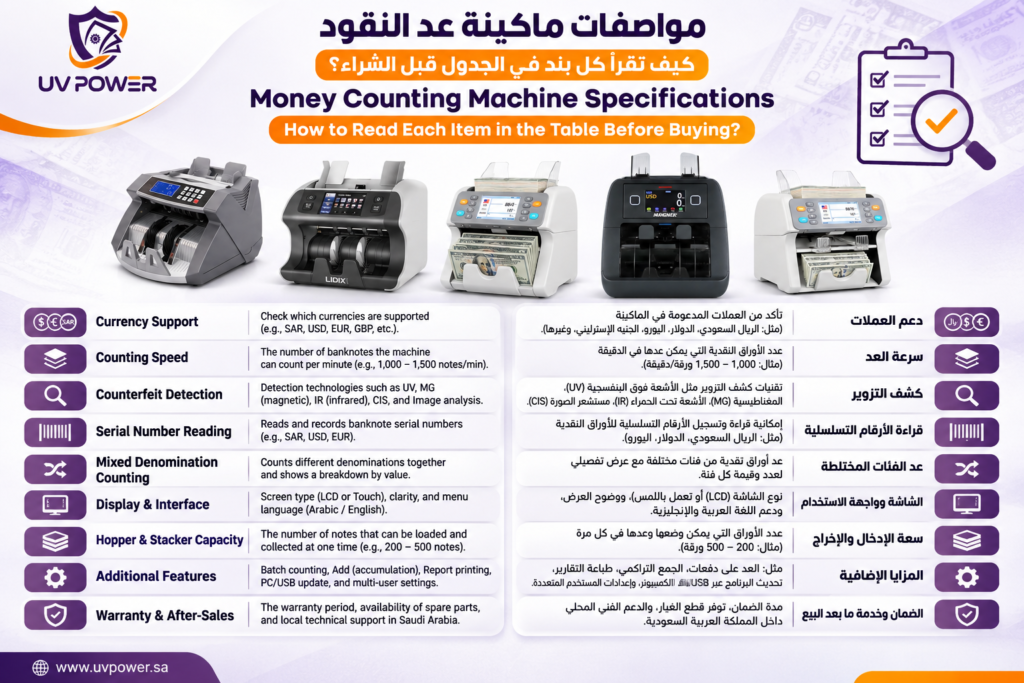
A money counter spec sheet is full of codes such as CIS 2, MT, IRR and S/N, so most buyers compare only speed and price. The result is often a fast machine that cannot total the amount, or an expensive one with features the business does not need.
This guide explains each line of the spec sheet in the order that matters when you buy, and ends with a reference table of every UV Power model, using the same figures as the product pages.
How to Read Money Counter Specifications in One Minute
Read the spec sheet in this order, and stop at the first line that does not fit your needs:
- Count modes: does the machine total the amount, or only count the notes? This is the most important line, and it splits the market in two.
- Detection: how many sensors check each note, and whether it reads serial numbers.
- Currencies: are the currencies you actually receive on the list? The total number of currencies matters less.
- Capacities and pockets: how many notes you can load at once, and whether there is a separate pocket for rejected notes.
- Speed: which counting mode was it measured in?
- Connectivity and updates: does it save counts, can it connect to a computer or printer, and how is its software updated?
- Warranty: how long it lasts, and who provides it (the seller or the agent).
Lines such as weight, country of origin and screen type come after that, and they rarely change the decision.
Count Modes in Money Counter Specifications: Count Only, Single, Mixed
The word "total" in a spec sheet means the machine calculates the amount in riyals, not just the number of notes.
| Mode on the spec sheet | What the machine does | When it is enough |
|---|---|---|
| Count only (Single) | Counts the notes and sets the quantity, but does not calculate the amount | Bundling notes of one known denomination |
| Single "total" | Counts one denomination and calculates its value, and stops if another denomination appears | Your cash arrives already sorted by denomination |
| Mixed "total" (Mix) | Counts a bundle of mixed denominations and shows the count of each denomination and the total | End-of-day cash drawers, and cash received from customers |
If your cash arrives mixed, mixed counting is what really makes the difference, because the alternative is sorting denominations by hand before counting. More in What is mixed counting? andCounting notes vs. calculating value.
Detection Codes in Money Counter Specifications
Each code is a sensor that checks a different feature of the note, and the more sensors there are, the less passes unchecked. But no machine can guarantee it will detect every counterfeit note.
| Code | What it checks | UV Power models that have it |
|---|---|---|
| UV | Ultraviolet light: how the banknote paper behaves under UV | All models except U-P100 |
| MG | Magnetic ink | All models except U-P100 |
| IR | Infrared light: features invisible to the naked eye | All models except U-P100 |
| MT | The metal security thread inside the note | L1, U-P500, U-P2000 |
| CIS | An image sensor that reads the note and identifies its denomination | L1 |
| CIS 2 (dual) | The same image sensor, reading both sides | U-P500, U-P2000, Lidix CL-2, Magner 2000V/F, Glory GFS-220C/F |
| S/N | Reads and stores the serial number of each note | U-P500, U-P2000, Magner 2000V/F, Glory GFS-220C/F |
| UVT, IRR, IRT | Additional counterfeit-detection sensors listed by the manufacturer | UVT: Lidix, Magner, Glory · IRR: Magner · IRT: Lidix |
| TDS | Detects torn, taped, holed or folded notes | Magner 2000F (the Glory GFS-220F also rejects torn, folded and taped notes) |
Two points most buyers miss:
- S/N is not counterfeit detection. It is a record of the notes that went through the machine, and it only works for certain currencies, which differ from the list of counting currencies. For example, the U-P500 and U-P2000 read serial numbers on riyals, dollars and euros, and Magner adds pounds sterling and UAE dirhams.
- TDS is not counterfeit detection either. It helps anyone who hands cash to a bank or a cash-in-transit company and needs notes in good condition.
A fuller explanation of the sensors in counterfeit detection technologies andWhat does CIS mean?. To read ad claims such as “11 layers” and “100% accuracy”, see counterfeit detection claims.
Capacities: Hopper, Stacker and Reject Pocket
Three numbers decide how often the operator has to step in during a count:
- Hopper capacity: how many notes you can load at once. On UV Power models it ranges from 200 to 600 notes.
- Stacker capacity: when it is full, the machine stops until you empty it. It is 200 to 250 notes on all models, so a 600-note hopper does not mean 600 notes without a stop.
- Reject and counterfeit pocket: on a single-pocket machine, counting stops at every suspect note. On a two-pocket machine, the note is diverted to a separate pocket and counting continues. Available on the U-P2000 (200 notes), and on the Magner 2000V/F and Glory GFS-220C/F (100 notes).
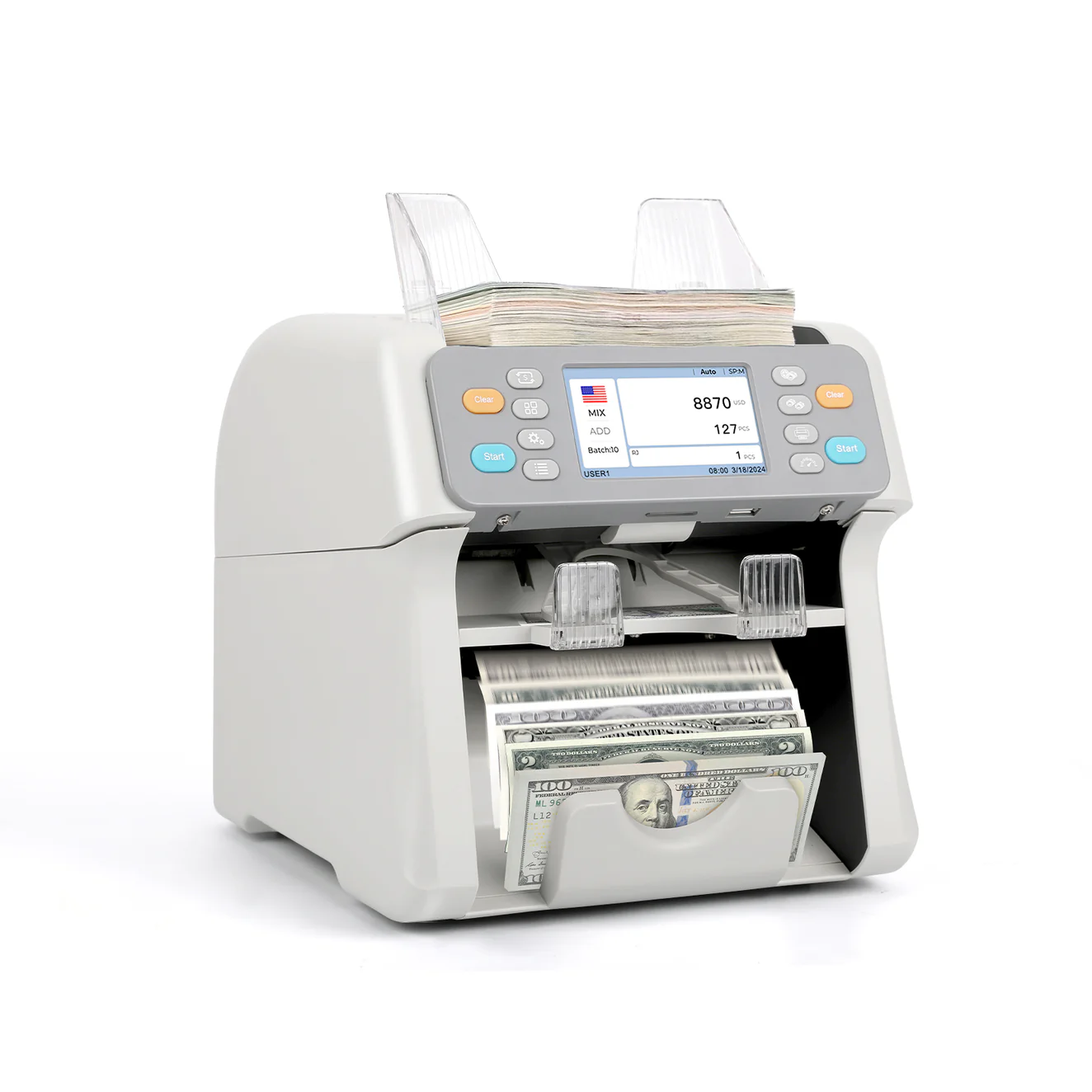
If you count thousands of notes a day and receive cash from many sources, a reject pocket saves more time than any increase in speed. Why notes get rejected: Why does a money counter reject some notes?
Currencies and Speed: Two Numbers That Get Misread
"20 currencies" does not mean your currency
The number alone is not enough: ask for the list of currencies by name, and ask what the machine does with each one: count, calculate value, or read serial numbers. The L1, for example, supports the Saudi riyal only, which is enough for most shops. On the other hand, a machine may support 30 currencies and still not include the one you actually receive.
Advertised speed: in which mode?
Most spec sheets list the top speed without explanation, and it is usually the count-only speed. Mixed counting is slower because the machine identifies the denomination of every note. An example from our range: the Magner 2000V and 2000F count 1,300 notes per minute in count-only mode, and 1,200 in mixed counting (Mix).
Always ask the seller for the mixed-counting speed if you will use it. And remember that the machine stops whenever the stacker is full or a note is rejected, so counting a drawer takes longer than the speed suggests.
Saved Counts, Accessories, Software Updates and Warranty
Saved counts and reports. Most machines show the result and then erase it with the next count. The Magner 2000V and 2000F store counts for up to 6 months, and the U-P500, U-P2000 and Magner machines connect to a computer through money counter software that saves every count and exports it to Excel or PDF.
Accessories. Check compatibility before you buy, because not every machine accepts every accessory:
- 58 mm report printer: L1, U-P300, U-P500, U-P2000, U-P1000. Magner has its own dedicated printer.
- the external display: U-P500, U-P2000, L1. Magner has its own dedicated display.
Software (firmware) updates. The machine needs one when a new denomination or a new series of the currency is issued, such as the sixth issue of the Saudi currency. The port decides who can run the update: USB on the L1, U-P500, U-P2000 and Glory; a dedicated factory device on the U-P300; SD card, WLAN and USB on the Lidix CL-2; and USB and Ethernet on the Magner 2000V/F.
Warranty. Check both the length and who provides it. U-P500 and U-P2000: three years directly from UV Power. Most other models: two years directly. Glory GFS-220C/F: two-year agent warranty.
Reference Table: UV Power Money Counter Specifications
Models are listed from the simplest to the most capable. Capacities in order: hopper / stacker / reject pocket.
| Model | Counting modes | Detection | Currencies | Capacities (notes) | Speed (notes/min) | Updates | Warranty |
|---|---|---|---|---|---|---|---|
| U-P100 | Count only | None | All currencies (count only) | 200 / 200 / — | 1,000 | — | Two years |
| U-P200 andU-P200 Battery | Count only | IR, MG, UV | 15 | 200 / 200 / — | 1,000 | — | Two years |
| U-P300 | Count only, single "total" | IR, MG, UV | 15 | 600 / 200 / — | 3 speeds, approx.: 800 / 1,000 / 1,500 | Dedicated factory device | Two years |
| Lite Counts L1 | Single, single and mixed "total" | CIS, IR, MG, MT, UV | Saudi riyal only | 250 / 200 / — | 800 / 1,000 / 1,200 | USB | Two years |
| U-P500 | Single, single and mixed "total" | CIS 2, IR, MG, MT, UV, S/N (3 currencies) | 20 | 600 / 200 / — | 800 / 1,000 / 1,200 | USB | 3 years |
| U-P2000 | Single, single and mixed "total" | CIS 2, IR, MG, MT, UV, S/N (3 currencies) | 20 | 600 / 200 / 200 | 800 / 1,000 / 1,200 | USB | 3 years |
| Lidix CL-2 | Single, single and mixed "total" | CIS 2, IR, IRT, MG, UV, UVT | 10 (more on request) | 500 / 250 / — | 800 / 1,000 / 1,200 | SD, WLAN, USB | Two years |
| Magner 2000V | Single, single and mixed "total" | CIS 2, IR, IRR, MG, UV, UVT, S/N (5 currencies) | 30 | 500 / 250 / 100 | 1,300 count only · 1,200 mixed | USB, Ethernet | Two years |
| Magner 2000F | Single, single and mixed "total" | Same as 2000V + TDS | 30 | 500 / 250 / 100 | 1,300 count only · 1,200 mixed | USB, Ethernet | Two years |
| Glory GFS-220C | Single, single and mixed "total" | CIS 2, IR, MG, UV, UVT, S/N (10 currencies) | 10 | 500 / 200 / 100 | 1,000 / 1,200 | USB | Two years (agent) |
| Glory GFS-220F | Single, single and mixed "total" | Same as 220C + rejects torn, folded and taped notes | 10 | 500 / 200 / 100 | 1,000 / 1,200 | USB | Two years (agent) |
Coin counters
| Model | Counting modes | Currencies | Hopper | Pockets | Speed (coins/min) | Warranty |
|---|---|---|---|---|---|---|
| U-P400 | Mixed "total" | New Saudi riyal coins only; rejects fake and non-Saudi coins | 200 | 300–400 coins per pocket | Up to 300 | Two years |
| U-P1000 | Mixed "total", batch counting | Old and new Saudi riyal coins; sorts out damaged and foreign coins | More than 800 | 7 pockets, the seventh for rejects (150 coins per pocket) | 400–600 (estimated) | Two years |
Current prices are on each model's page. For a direct comparison of three models: U-P300 vs. U-P500 vs. U-P2000.
Frequently asked questions
What is the most important line in money counter specifications? Count modes. If your cash arrives in mixed denominations, a machine without mixed counting will not give you the amount, however fast it is.
Do more sensors mean better detection? Usually yes, because each sensor checks a different feature. But S/N and TDS are not counterfeit detection, and no machine can guarantee it will detect every counterfeit note.
What is the difference between CIS and CIS 2? CIS 2 reads the note from both sides; CIS reads one side.
Does a speed of 1,500 notes per minute mean the machine gets the job done faster? Not always. Ask for the speed in the counting mode you will use, the stacker capacity, and whether there is a reject pocket.
Do all machines read serial numbers? No. In the UV Power range: the U-P500 and U-P2000 for riyals, dollars and euros; the Magner 2000V/F for those three plus pounds sterling and UAE dirhams; and the Glory GFS-220C/F for its ten currencies.
Do I need a reject pocket? If you count large amounts from many sources, yes, because it stops the count from pausing at every rejected note. For a single count at the end of the day, a single-pocket machine is enough.
Comparing offers? Send us any machine's spec sheet on WhatsApp, and we will explain each item and its equivalent in our models.
Read also:
- Money Counting Machine Buying Guide for Saudi Arabia
- How Does a Money Counting Machine Work?
- Money counter software and reports
